Trustpilot



The Reshuffle
AI is moving through the British workforce. This report shows where the work is today, what the machines can now do, which jobs carry the risk, and which jobs hold protected ground. It ends with the moves a working person can make. Every figure links to its source.


What will AI do to your job?
Type your job below, or pick one. Each verdict is built from the evidence in this report: exposure from the UK and global studies, demand from the live market data, options from the moves chapter. Every card lists its numbered sources.
Will AI replace accountants?
The reach. Accountancy sits in the top 20 most AI-exposed UK occupations. Employers rank accounting, book-keeping and payroll clerks, and accountants and auditors, among the fastest-declining roles to 2030.
What holds. Sign-off, audit opinion and liability stay with an accountable person. The cuts land at the entry rung: Big 4 graduate intakes fell by up to a third in two years.
Your options. Own the AI workflow in your practice (AI skills carry a 56% wage premium), move up to advisory work, or price a protected move in chapter 10.
Will AI replace book-keepers and payroll clerks?
The reach. Book-keepers and credit controllers appear on both DfE most-exposed lists, and accounting and payroll clerks sit on the WEF fastest-declining list.
What holds. 378,700 people do this work today. Exception-handling, employer trust and running the software outlast the keying-in.
Your options. Become the person who operates and checks the automated ledger, move into management accounts, or take a protected route in chapter 10.
Will AI replace solicitors and paralegals?
The reach. Solicitors rank second on the DfE list of occupations most exposed to large language models. Legal secretaries are on the WEF fastest-declining list. Drafting, research and document review automate first.
What holds. Rights of audience, regulated advice, negotiation and liability stay human. The US payroll data shows experienced professionals holding while junior hiring falls.
Your options. Run the tools inside your firm, move toward client-owning and advocacy work, and protect the junior rung you stand on by becoming its supervisor.
Will AI replace management consultants and business analysts?
The reach. Management consultants and business analysts top the DfE ranking of AI-exposed UK occupations. Research, analysis and deck production are core AI tasks already.
What holds. The client relationship and accountability for advice. Partners hold; the analyst layer beneath them thins.
Your options. Move toward owned client relationships, or take the AI-operations seat: the person who runs the machine now does the analyst work of five.
Will AI change finance and banking jobs?
The reach. Finance and insurance is the most AI-exposed UK sector. Financial managers, analysts, actuaries and economists all sit in the DfE top 20.
What holds. Regulated advice, risk ownership and relationships. Fintech engineering is one of the fastest-growing jobs to 2030, so the sector reshuffles more than it shrinks.
Your options. Move toward regulated, client-owning or risk-owning seats; add AI skills, which carry the largest premium in every industry analysed.
Will AI replace customer service jobs?
The reach. The first roles named in every chief executive statement. UK customer service adverts are down 23% against 2019, and 45% of call centre staff are under 30, the cohort the doors are closing on.
What holds. Escalations, judgement and quality. Klarna cut the humans, admitted lower quality, and hired them back. 413,500 people do this work.
Your options. The skills transfer straight into security work: reading people, staying calm, de-escalating. Median full-time pay is £5,800 higher. See chapter 10.
Will AI replace receptionists?
The reach. Administrative adverts are down 22% against 2019, and booking, routing and answering are exactly the tasks AI now does.
What holds. Where presence is the product (clinics, hotels, corporate front of house), the person stays and the role blends toward guest experience and security.
Your options. Front-of-house security is the natural upgrade: a licensed, higher-paid version of the same skills. See chapter 10.
Will AI replace admin and office jobs?
The reach. 3.04 million people work in administrative and secretarial occupations. Adverts are down 22% against 2019; admin assistants and data entry clerks lead the WEF declining list; a third of the UK workforce sits in the high-exposure, low-complementarity cohort.
What holds. The people who run, check and correct the systems. Senior PA work built on trust holds better: £34,954 median full-time.
Your options. Take the free government AI courses and become the office AI operator, or price a protected move in chapter 10.
Will AI replace bank tellers and cashiers?
The reach. Bank tellers and cashiers sit near the top of the WEF fastest-declining list. The decline started before AI; AI accelerates it.
What holds. Face-to-face service where the branch or store keeps a human front line.
Your options. Retail security pays more on the same shop floor, and retailers are spending £5.5 billion on crime prevention. See chapter 10.
Will AI replace HR jobs?
The reach. HR administration sits on both DfE most-exposed lists. IBM automated 94% of routine HR tasks and removed a few hundred roles.
What holds. Employee relations, hard conversations, hiring accountability. IBM redeployed the savings into hiring elsewhere.
Your options. Own the judgement work and the AI systems that do the administration underneath it.
Will AI replace marketing and PR jobs?
The reach. PR professionals and marketing associates sit in the DfE top 20. Writing is one of the most-automated task families in real AI usage data.
What holds. Strategy, taste, brand judgement and client trust. AI-skilled marketers earn the premium; volume content producers feel the squeeze.
Your options. Be the marketer who runs the machine: the 56% AI-skills premium applies in every industry analysed.
Will AI replace graphic designers?
The reach. Graphic designers newly entered the WEF fastest-declining list, which its authors read as evidence of generative AI reaching knowledge work. Production design automates first.
What holds. Art direction, identity and taste. UI and UX design sits on the growing list in the same report.
Your options. Move up the stack from production to direction, or sideways into UX, and run the generative tools yourself.
Sources: 2
Will AI replace writers and journalists?
The reach. Writers, journalists, technical writers and proofreaders all sit in the top 20 of Microsoft's analysis of 200,000 real AI conversations.
What holds. Reporting, access, original judgement and a name readers trust. Commodity copy goes first.
Your options. Own beats and relationships the machine cannot phone, and use the tools for the production layer.
Sources: 17
Will AI replace translators and interpreters?
The reach. Interpreters and translators score highest of all occupations for AI applicability in Microsoft's study (0.49 of 1).
What holds. Certified legal interpreting, safety-critical settings and live nuance under liability.
Your options. Specialise where certification and accountability are required, or move the language skill into client-facing roles.
Sources: 17
Will AI replace telesales and telemarketing?
The reach. Telephone salespersons top the DfE list for exposure to language models, and telemarketers sit on the WEF declining list.
What holds. Complex, relationship-led selling. Transactional calling automates first.
Your options. Move to field or relationship sales, where presence and trust carry the deal.
Will AI replace software developers?
The reach. Coding is the single largest use of AI in real usage data, and software development is one of two occupations named in the Stanford payroll study: employment for 22 to 25 year olds in exposed jobs sits about 19% below trend.
What holds. Experienced engineers held steady in the same data, and software developers sit on the WEF fastest-growing list. Architecture, review and ownership of agent output are the seats that grow.
Your options. Get senior fast: own systems, review the machines' work, run agent fleets. The entry route is the hard part now.
Will AI replace data analysts?
The reach. Analysis tasks automate quickly, and AI does the querying and charting on request.
What holds. Big data specialists and data analysts sit on the WEF fastest-growing lists: the work shifts from producing analysis to owning data, quality and decisions.
Your options. Add the AI skills and take the premium; the demand side of this occupation is on your side.
Will AI replace teachers?
The reach. Further and higher education teaching appear on the DfE language-model exposure list: marking, materials and admin automate first.
What holds. The classroom is presence work with safeguarding duties. Teaching is the UK's largest advertised sector, up 28.5% in the year to May 2026.
Your options. Stay, and let the tools take the marking. Vocational training (including security training) is a growing route for experienced practitioners.
Will AI change civil service and council jobs?
The reach. National and local government administrative occupations sit on the DfE most-exposed lists, and the government has flagged around 10,000 back-office roles with a £2 billion annual savings target.
What holds. Statutory casework, discretion and public-facing service. The state is automating its own paperwork first.
Your options. Move toward casework and inspection roles, or take the AI-operations seat as departments adopt the tools.
Will AI replace middle managers?
The reach. No UK dataset isolates middle-management postings yet, and this report will not invent one. The mechanism is real: when a team of ten becomes four people plus agents, the coordination layer above it merges.
What holds. Managers who own clients, revenue or risk. Project managers sit on the WEF growing list: orchestration of people and machines is a live skill.
Your options. Attach yourself to an edge the firm keeps: clients, product, field operations, or the AI systems themselves.
Will AI replace security guards?
The reach. Honest answer first: the DfE study names security guards as the exception among low-skill occupations, because watching screens automates. That slice, CCTV, is 13.2% of licences.
What holds. The licensed person at the door is protected three ways: the law requires a human (a criminal offence without an SIA licence), robots lack the dexterity and judgement, and demand is rising: licences up 25% in five years, Martyn's Law duties on 178,900 premises from spring 2027, police numbers below their 2010 peak.
Your options. A week of licence-linked training opens the door. Start at get-licensed.co.uk, then progress: supervision, close protection, security management.
Is door supervision a safe career?
The reach. The watching automates; the standing does not. Door work is judgement, de-escalation and lawful intervention in an unpredictable environment, the hardest class of work to automate.
What holds. Door supervision is 70.4% of all active SIA licences, and Martyn's Law brings statutory duties to venues from spring 2027.
Your options. Add specialisms as you go: CCTV, close protection, supervision. Training routes at get-licensed.co.uk.
Will AI replace CCTV operators?
The reach. This is the exposed slice of security. AI video monitoring is exactly the use the DfE study cites, and 67,481 licences sit in this specialism.
What holds. A person still owns the response: verification, dispatch, evidence and liability. Control rooms shrink before they vanish.
Your options. Add a door supervision or guarding licence and move toward the response side, where the protection is strongest.
Is close protection AI-proof?
The reach. Almost none. Close protection is judgement, planning and physical presence around a principal.
What holds. 11,866 active licences: a premium specialism reached through experience and further training.
Your options. The standard progression route from door and guarding work for strong operators.
Sources: 22
Will AI replace electricians?
The reach. Electricians appear on neither DfE most-exposed list. Unpredictable physical work is about 25% automatable against 81% for predictable factory work.
What holds. The gap is 104,000 more electricians needed by 2032, the largest of any trade, pulled by heat pumps, EV charging and grid work. Median full-time pay beats the national median. Part P makes notifiable domestic work a registered person's job.
Your options. A four-year apprenticeship, earning throughout. Many fund the transition with licensed security work.
Will AI replace plumbers?
The reach. McKinsey's task data names plumbers among the jobs least likely to automate: every job is a different house, a different fault.
What holds. 73,700 more plumbers are needed by 2032, and the heat pump target needs roughly nine times the 2022 installer base by 2028.
Your options. Adult retraining and apprenticeships; gas work needs Gas Safe registration. Self-employed earnings sit above the employee medians shown here.
Will AI replace gas engineers?
The reach. Gas work is legally gated: nobody may do it without Gas Safe registration, and it happens in unpredictable homes.
What holds. The heat transition is the demand engine: 600,000 heat pump installations a year targeted by 2028 against roughly 3,000 trained installers in 2022.
Your options. Add heat pump qualifications to a gas ticket and stand in the widest supply gap in the trades.
Will AI replace roofers?
The reach. Roofers sit at or near the bottom of both the UK exposure ranking and Microsoft's study, scoring 0.01 of 1 for AI applicability. The strongest cross-study convergence in the literature.
What holds. Construction needs 239,300 extra workers by 2029.
Your options. Roofing, scaffolding and the wet trades share the same protection: unpredictable sites, real weather, real ladders.
Will AI replace builders and bricklayers?
The reach. Bricklayers, plasterers and elementary construction occupations fill the DfE least-exposed list.
What holds. CITB forecasts 239,300 extra construction workers needed by 2029, about 47,860 a year.
Your options. Entry is open at every age; specialise into the gap trades (electrical, plumbing, carpentry) as you go.
Will AI replace plasterers, painters and decorators?
The reach. Plasterers, painters and decorators, and floorers and wall tilers all sit in the DfE twenty least-exposed occupations.
What holds. Finishing trades ride the same construction demand: 239,300 extra workers needed by 2029.
Your options. Short courses open the door; quality and reliability build the book of work.
Will AI replace carpenters and joiners?
The reach. Bespoke physical work in unpredictable buildings: the least automatable class of task.
What holds. CITB forecasts 4,800 more carpenters and joiners needed by 2029 within the wider construction gap.
Your options. Apprenticeship or adult retraining; fit-out and heritage work carry premiums.
Will AI replace care workers?
The reach. Almost none of this job is a screen task. 894,400 people do it, and an ageing population guarantees the long-term demand.
What holds. The honest near-term caveat: healthcare and nursing adverts fell 33% in the year to May 2026, so the market runs colder than the demographics.
Your options. Care experience transfers into senior care (£29,381 median), nursing routes, and front-of-house security in health settings.
Will AI replace nurses?
The reach. Nursing is registered, physical, in-person work. AI takes the notes and the admin around it first.
What holds. Nursing professionals sit among the largest-growing jobs to 2030 globally, while UK postings run below baseline this year. Structure says up; the current market says wait.
Your options. The registration is the moat. Specialisms and prescribing qualifications deepen it.
Will AI replace doctors?
The reach. Medical practitioners had the lowest automation probability in the ONS analysis. Diagnosis support augments; the examination, the procedure and the accountability stay.
What holds. Registration, liability and an ageing population.
Your options. Adopt the tools early; the doctors who run AI well will carry larger panels.
Sources: 35
Will AI replace dentists, physios, radiographers and vets?
The reach. The DfE names vets, radiographers, dentists and physiotherapists as the least AI-exposed professional occupations.
What holds. Hands, patients and registration. AI reads the scan; the professional treats the person and carries the risk.
Your options. These are destination professions: long training, strong moats.
Sources: 1
Will AI replace police officers?
The reach. Senior police officers sit on the DfE least-exposed professional list. Warranted powers and physical response stay human.
What holds. Officer numbers are 4.1% below the 2010 peak with a larger population, which is one reason private security demand rises.
Your options. Policing experience transfers directly into licensed security leadership, investigations and close protection.
Will AI replace chefs and hospitality staff?
The reach. Kitchens and service are physical, in-person work: low AI exposure. The pressure here is economic. The government's own assessment notes hospitality, a low-exposure sector, accounted for 53% of UK job losses in the year to August 2025, driven by costs and demand.
What holds. Hospitality postings fell 32% in the year to May 2026. The jobs resist AI; the sector is squeezed anyway.
Your options. The night-time economy runs on licensed security too: door supervision is a common second income for hospitality workers.
Will AI replace cleaners?
The reach. Cleaners, window cleaners and launderers fill the DfE least-exposed list: every room is different, which defeats the robots.
What holds. Employers globally still expect fewer caretaker and cleaner roles by 2030, so pay pressure stays. The work resists machines more than it resists cost-cutting.
Your options. Specialist and industrial cleaning pay better; supervision routes exist in facilities management.
Will AI replace hairdressers and barbers?
The reach. Nobody sends a robot their head. Personal, dexterous, in-person work is the least automatable class of task there is.
What holds. The demand is local and steady; the constraint is price, competition and footfall.
Your options. Chair rental and mobile work keep the economics in your hands.
Sources: 27
Will AI replace retail workers?
The reach. 831,800 people work in retail sales. Checkout automation predates AI; shop salespersons still sit among the largest-growing jobs globally because stores keep needing people.
What holds. Retail crime is the growth line: violence and abuse run at 3.5 times pre-pandemic levels, and retailers spent £5.5 billion on prevention in five years.
Your options. Retail security is the same shop floor with a licence and better pay: see chapter 10.
Will AI replace warehouse workers?
The reach. A split verdict. Fork-lift drivers sit on the DfE least-exposed list for language models, but warehouse work is predictable physical activity, the class McKinsey scores about 81% automatable as robotics matures.
What holds. Logistics postings fell 32% in the year to May 2026. The robots arrive shed by shed, so timing varies by employer.
Your options. Licences travel well from this work: driving categories, trades apprenticeships, or security.
Will AI replace lorry and delivery drivers?
The reach. Large goods vehicle drivers sit on the DfE least-exposed list for language models, and delivery drivers are among the largest-growing jobs to 2030 in the WEF survey.
What holds. The watch item is autonomy, and it runs on the slow curve: PwC put the transport automation risk in the 2030s wave, and the SMMT told Parliament most of the UK fleet stays human-driven for decades because vehicles average 14 years on the road.
Your options. HGV categories, ADR and specialist work raise pay now; keep one eye on the autonomy timeline.
Will AI replace taxi and Uber drivers?
The reach. The robotaxi status, honestly: as of September 2026 nothing driverless carries paying UK passengers. Uber and Wayve hold London licences for trials with a safety driver; Waymo is testing; the full legal framework lands in late 2027.
What holds. England has a record 417,300 taxi and private-hire driver licences, up 9% in two years. Algorithmic management already runs the work, and the Supreme Court made platform drivers workers with minimum-wage rights.
Your options. Executive and chauffeur work deepens the human moat; an SIA close protection licence turns driving into security-driving. Watch the pilots, and read chapter 2 on why physical rollouts run slow.
Where do gig workers go?
The reach. Between half a million people (the strict count of platform gig workers) and 4.4 million (everyone doing weekly platform work) sit here, depending on the definition. The work is already run by algorithms: an Oxford study of 1.5 million UK Uber trips found driver pay fell and became less predictable after algorithmic pricing arrived. AI deepens that management layer first; autonomy threatens the driving and riding last, on the slow physical curve.
What holds. The 2025 Employment Rights Act brings guaranteed-hours rights to zero-hours workers from 2027, and it left self-employed platform riders largely outside it. Thin protection is the structural fact of this work.
Your options. The move that changes the economics is a licence: it converts hustle into a trade with a legal moat. SIA security work is the fastest licence to earn with (about a week of training); trades apprenticeships are the deeper build. See chapter 10.
What should I train for now?
The reach. The entry level of desk work is where the doors are closing: 140 applications per graduate vacancy, entry postings down 32% since ChatGPT, youth unemployment at a decade high.
What holds. The protected ground is hiring: the electrician gap is 104,000 by 2032, construction needs 47,860 people a year, and security licences grew 25% in five years.
Your options. Read the ladder, then the moves. A licence or a trade now beats a generic degree aimed at a generic office.
Your role is one we have not listed
The test. Run it through the three walls of chapter 8. Does the machine lack the hands for it? Does the law require a licensed person? Is your presence the product?
The reading. If the answer is no to all three and most of your day happens on a screen, treat your role as exposed and read the ladder in chapter 6.
Your options. The moves in chapter 10 apply to every exposed desk role, whatever its title.
The searches show who is worried. The roles the world most asks "will AI replace" about are programmers, software developers, accountants, lawyers and data analysts.51 UK polling matches: the workers most likely to think AI could take their own job are in admin (43%) and sales and customer service (41%); the skilled trades (20%) and care (18%) worry least.52 The worry map is the exposure map of chapter 4, drawn by the workers themselves.
How the verdicts are made: AI exposure comes from the studies in chapter 4 (DfE, DSIT, IMF, Microsoft, WEF), demand from the live market data in chapters 5, 8 and 9, options from chapter 10. High exposure means AI can already do many of the role's tasks; it never by itself means the job disappears. Chapter 3 explains why.
Chapter 1
The workforce today
Start with the baseline. 34.5 million people are in work in the UK.53 Nine occupation groups hold them. The chart below is the single most useful picture in this report: everything that follows is about which of these bars AI reaches first.
Where 34.5 million working people sit
All in employment aged 16 and over, by SOC 2020 major group, April 2025 to March 2026. Dark bars mark the groups where the advert data already shows the sharpest falls. Green marks the skilled trades.
Source: ONS Annual Population Survey via Nomis.5 Shares of all in employment; a small share state no occupation.
Three facts about this picture matter for everything that follows.
First, Britain is a desk economy. Managers, professionals and associate professionals are 53.5% of all employment. Add administrative, secretarial, sales and customer service work and roughly two thirds of British jobs are done at a desk, a counter or a phone.5
Second, the physical economy is smaller than people think. Skilled trades are 8.2% of employment. Caring and other service work is 8.7%. These jobs happen in buildings, streets and homes, with tools and with people.
Third, pay follows the desk. The desk groups out-earn the physical groups on median pay. That ordering was built over decades. This report shows why parts of it are now in question.
What each group earns
Median gross annual pay, full-time employees, April 2025.
Source: ONS Annual Survey of Hours and Earnings, 2025 provisional.6 Employees only; the self-employed sit outside ASHE, which understates trades earnings.
The occupations this report tracks
The report follows nine specific occupations through every chapter: the exposed desk roles on one side, the protected physical roles on the other.
| Occupation | SOC 2020 | People | Median pay (full-time) | Chapter 8 verdict |
|---|---|---|---|---|
| Customer service occupations | 721 | 413,500 | £28,036 | Exposed |
| Book-keepers, payroll and wages clerks | 4122 | 378,700 | £31,560 | Exposed |
| Other administrative occupations | 4159 | 554,000 | £28,294 | Exposed |
| Receptionists | 4216 | 149,000 | £24,678 | Exposed |
| Sales and retail assistants | 7111 | 831,800 | £25,056 | Pressured |
| Care workers and home carers | 6135 | 894,400 | £27,468 | Protected |
| Security guards and related | 9231 | 158,600 | £33,832 | Protected, licensed |
| Plumbers and heating engineers | 5315 | 153,700 | £37,881 | Protected, certificated |
| Electricians and electrical fitters | 5241 | 193,000 | £39,647 | Protected, certificated |
Employment: Annual Population Survey, April 2025 to March 2026.5 Pay: ASHE 2025 provisional, median gross annual, full-time.6 The verdicts are argued in chapter 8, with the counter-evidence shown.
Who sits in the exposed seats
Age decides who feels the reshuffle first. The occupations with the youngest workforces are the ones the advert data shows shrinking. The protected occupations skew older, which creates openings.
Share of workers under 30
Census 2021, England and Wales, selected occupations. Dark bars are exposed desk and counter roles. Green bars are the protected trades and security.
Source: ONS Census 2021, occupation by age.9 Security guards: 17.2% under 30, 39.3% over 50.
Nearly half of call centre staff are under 30. Two in five retail assistants are under 30. In security, fewer than one in five are. The young are concentrated in exactly the work the next chapters show under pressure, and the protected occupations have room at the young end.
Geography points the same way. In London, the three most exposed desk groups are 66.6% of all employment, against 53.5% nationally. The trades, care and security are spread across the whole country.5
The gig economy cuts across the picture
Platform work sits over these occupation groups, and its size depends entirely on the definition. On the strict count (people whose gig work runs through a platform), about 463,600 people.44 On the broad count (anyone doing platform work at least weekly), 4.4 million in England and Wales by 2021, nearly triple the 2016 share.45 England holds a record 417,300 taxi and private-hire driver licences, up 9% in two years.41
Two facts frame the gig chapters of this report. The algorithm already manages this work: an Oxford study of 1.5 million UK Uber trips found driver pay fell and became less predictable once algorithmic pricing arrived.43 And the law is moving slower than the apps: the Supreme Court made platform drivers workers with minimum-wage rights, while the 2025 Employment Rights Act left self-employed riders largely outside its new protections.4246 Where gig workers can go sits in the role checker above and in chapter 10.
Two thirds of British work is done at a desk, a counter or a phone. The rest is done with hands, in rooms, on streets. Hold that split. The whole report turns on it.
Chapter 2
What the machines can now do
In November 2022 a chatbot could draft a passable email. In 2026 frontier systems complete real professional tasks at expert level, run for hours without supervision, and cost pennies. This chapter shows the climb with numbers, then states what is coming in the next 24 months.
The releases that moved the line
o1: reasoning models
Models that think before answering. PhD-level science accuracy passes human experts.56
Computer use
A frontier model operates a computer the way a person does: screen, cursor, keyboard.57
DeepSeek R1
Open-weight reasoning at a fraction of the training cost. A trillion dollars leaves US tech stocks in a day.58
The agent year
Claude Code, Operator, ChatGPT agent: models stop answering questions and start completing jobs of work.59
The frontier tier
Claude Fable 5, GPT-5.6 and Claude Opus 5 arrive. Governments now test frontier models before release.62
The capability climb, measured
SWE-bench scores models on real software engineering tasks from GitHub. GPQA Diamond asks PhD-level science questions. Human PhD experts score about 65% on GPQA.
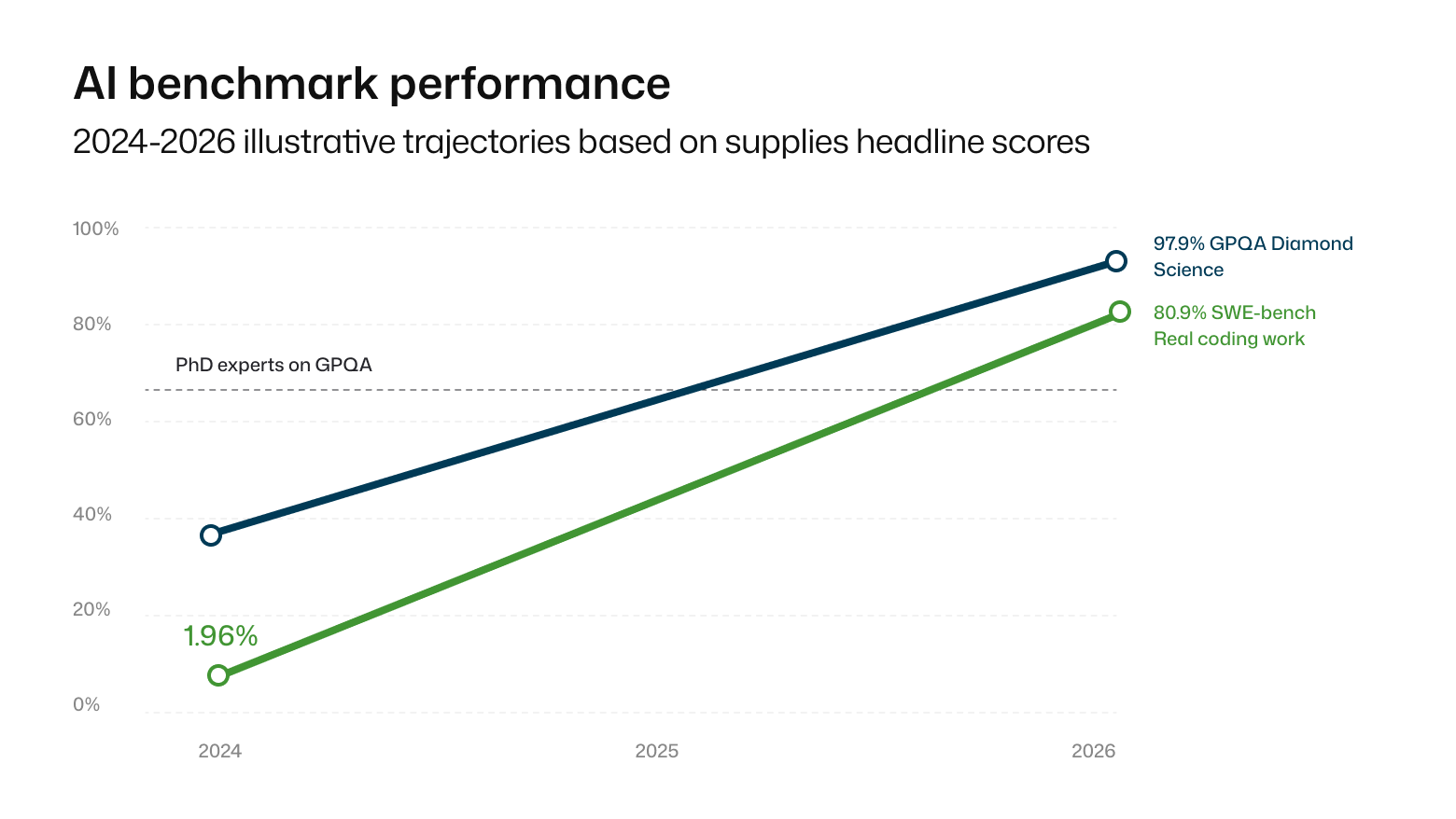
Sources: benchmark papers and model announcement pages.63646061 Coding went from 1.96% to 80.9% in 25 months.
Benchmarks can feel abstract. Three measures translate the climb into working terms.
Fall in the price of matched AI capability in 21 months, March 2023 to December 2024. Frontier work now costs pennies per task.
Epoch AI65Length of human-professional task frontier agents now complete unsupervised half the time. The doubling time shrank from 7 months to 4.
METR6667Share of real professional deliverables, set by experts across 44 occupations, where the best model matched or beat the human expert.
OpenAI GDPval, Sep 202568UK firms using or planning to use AI. Large firms 36%, micro firms 14%. The adoption gap is the lag in the whole system.
DSIT, Jan 202612The next 24 months
What is announced, with money committed: OpenAI's Stargate programme has over $400 billion committed to roughly 7 gigawatts of US compute, with most capacity landing 2027 and 2028.69 Anthropic is building $50 billion of US data centres, first sites live in 2026.70 Anthropic's chief executive says systems he describes as a country of geniuses in a data centre may arrive within one to two years.71 DeepMind's chief executive puts AGI around 2029 or 2030.72 Treat the dates as claims by interested parties. Treat the compute as fact: the buildings are going up.
What this means in plain terms: the capability curve in the chart above has committed fuel through 2028. Model releases reported but unconfirmed (Grok 5, Gemini 3.5 Pro, GPT-6) are labelled as such in the sources and carry no weight in this report's reasoning.
The exception: hands
One capability is moving slowly: physical work in unpredictable places. The pattern has a name, Moravec's paradox. Skills that feel effortless to humans, such as picking things up and moving through a cluttered room, took evolution millions of years to build. They are far harder to engineer than the abstract reasoning that feels difficult to us.73
The state of the robots makes the point. Tesla's chief executive admitted in January 2026 that zero Optimus robots were doing useful factory work.74 Figure has delivered a few hundred humanoids to controlled sites.75 The veteran roboticist Rodney Brooks calls human-level dexterity from today's approaches pure fantasy thinking, and expects deployable dexterity to stay far behind humans beyond 2036.76 McKinsey's task data made the same split a decade ago: predictable physical activities are about 81% automatable with known technology, unpredictable physical work about 25%.27
Language, analysis and screen work: advancing fast, getting cheap, with committed fuel to 2028. Hands, doors and streets: advancing slowly. That gap decides who is exposed in the next chapters.
Chapter 3
What productivity actually means
Productivity is output per person. When a tool raises output per person, a firm faces a choice: make the same output with fewer people, or make more output with the same people. Everything in the AI and jobs debate is that one sentence playing out across 34 million jobs.
Which way a firm jumps depends on demand. When the cost of a piece of work falls, buyers sometimes buy much more of it. Cheaper software has meant more software and more software jobs for forty years. When buyers want no more of the output than before, cheaper work means fewer people producing it. Customer support is the live example: no company wants more support tickets because handling them got cheaper.
This is why the same technology grows some jobs and shrinks others, and why the honest answer to "will AI cut jobs" is: it depends on what happens to demand for each job's output. That test runs through every verdict in this report.
What happened last time
The last automation scare gives the base rate. In 2013, researchers scored 47% of US jobs at high risk of computerisation.77 The OECD went back a decade later to see what happened. Its finding, quoted exactly: "There is no support for net job destruction at the broad country level. All countries experienced employment growth over the past decade. Within countries, however, employment growth has been much lower in jobs at high risk of automation (6%) than in jobs at low risk (18%)."78
So the jobs did not vanish. They grew three times slower. In the UK, the Resolution Foundation found jobs rated highly automatable actually grew between 2013 and 2019, car washers by 38%.79 Hiring slows in the exposed jobs while growth pools elsewhere: that is what a technology wave does to a labour market. Hold that shape; the live data in chapter 5 matches it.
The productivity evidence this time
The early gains are real and measured. In the industries most exposed to AI, productivity growth nearly quadrupled: 7% across 2018 to 2022, then 27% across 2018 to 2024. Revenue per employee grew 27% in the most exposed industries against 9% in the least exposed.4 One worker, more output. That is the "fewer people doing more work" engine, running.
What the employers say, and what they did
Executives now say it in memos. The table separates the claim from the verified outcome, because three of the loudest early claims partly reversed.
| Company | The claim | What actually happened |
|---|---|---|
| Amazon | June 2025 memo: AI agents mean "we will need fewer people doing some of the jobs that are being done today".80 | About 14,000 corporate roles cut in October 2025, with more signalled for 2026. AI named as one driver among several.81 |
| Salesforce | September 2025: support cut from about 9,000 to about 5,000 heads, AI handling half of conversations.11 | Cuts executed. Hundreds redeployed to sales and services. Company claim, unaudited. |
| BT | May 2023: up to 55,000 fewer jobs by 2030, around 10,000 replaced by AI.82 | Plan standing. The next chief executive said in 2025 that AI could allow deeper cuts.83 The largest UK case on record. |
| Klarna | February 2024: its AI assistant did the work of 700 customer service agents.84 | May 2025: hiring humans again after the chief executive admitted the AI-led service meant lower quality.10 |
| IBM | May 2023: hiring pause on about 7,800 back-office roles AI could replace.85 | By 2025: a few hundred HR roles automated, total employment up, savings spent on programmers and sales.15 |
| UK Civil Service | March 2025: job cuts with AI adoption, savings target above £2 billion a year by 2030.20 | Around 10,000 back-office roles flagged. Programme in progress. |
Read the table as an economist and the pattern is clear. The cuts that stuck sit where demand for the output is fixed: support tickets, back-office processing, coordination. The reversals happened where quality is the product and buyers noticed the difference. In 2025, 17% of UK employers said they expected AI to reduce their headcount within a year; 6% expected an increase.86
Productivity means fewer people for the same output. Jobs survive where demand for the output grows, or where the machine has no reach. The next chapter maps where the machine's reach actually is.
Chapter 4
What the exposure studies find
Every serious institution has now measured which jobs overlap with what AI can do. The studies disagree on size. They agree on direction, and they agree on who sits where.
| Study | Headline finding |
|---|---|
| IMF, Jan 202487 | 60% of jobs in advanced economies are exposed to AI. Roughly half of those may benefit; for the other half, AI can execute key tasks, lowering demand for the person. |
| Goldman Sachs, 202388 | The equivalent of 300 million full-time jobs exposed to automation globally; two thirds of US occupations partially exposed; a 7% lift to global GDP. |
| Department for Education, 20231 | The UK occupation ranking. Most exposed: clerical professional work in finance, law and business management. Least exposed: technically difficult manual work in unpredictable places. |
| DSIT and AI Security Institute, Jan 202612 | About 70% of UK workers are in occupations with tasks AI could perform. A third of the workforce sits in the high-exposure, low-complementarity cohort. |
| Microsoft Research, 202517 | 200,000 real Copilot conversations mapped to occupations. Top overlap: translators, writers, customer service. Bottom: roofers, machine operators, physical trades, all scoring near zero. |
| Anthropic Economic Index, 2025 to 20261621 | Real usage data. Augmentation and automation trade the lead on the consumer side; business API usage runs 77% automation. Usage concentrates in mid-to-high wage desk occupations. |
| WEF employer survey, 20252 | Employers expect 170 million jobs created and 92 million displaced by 2030, net +78 million, with clerical roles declining fastest. |
| Acemoglu, 202489 | The sceptical anchor: existing task estimates justify at most a 0.66% productivity gain over ten years. If he is right, the whole reshuffle runs slower. |
The UK workforce, split three ways
UK government assessment of AI exposure, January 2026. The middle bar is the cohort this report calls exposed: high task overlap, low complementarity.
Source: DSIT and AI Security Institute, using the IMF method.12 The same assessment reports task-level productivity gains of 59% on writing tasks and 56% on software development.
The gradient reversed
The 2013 automation literature found risk concentrated in low-wage routine work; wages and education correlated negatively with risk.77 The AI-era studies find the opposite. The Department for Education is explicit: employees with more advanced qualifications are typically in jobs more exposed to AI, and the least exposed jobs are manual, technically difficult, and done in unpredictable environments.1 London and the South East carry the highest exposure of any UK region.1
A degree was the shelter in the last wave. In this wave the shelter moved to the physical world, and to the licence.
Exposure is a measure of tasks, and displacement is a market outcome
Every study above carries the same warning, and this report keeps it. Microsoft's researchers, on their own findings: "our study does not draw any conclusions about jobs being eliminated", and "A job is far more than the collection of tasks that make it up."90 The exposure scores say where the machine's reach is. Whether reach becomes replacement depends on demand, on quality, on liability, and on law. Chapters 5, 8 and 9 test each of those against live data.
Every study points the same way: the reach of AI covers the desk, and stops at work done with hands in unpredictable places. A third of the UK workforce sits in the high-exposure, low-complementarity cohort.
Chapter 5
What the job market is already saying
Forecasts argue. Adverts count. This chapter reads the live hiring data, and it shows the reshuffle arriving exactly where the exposure studies said it would: at the entry level of desk work.
The vacancy market has halved from its peak
UK job vacancies, thousands, ONS employer survey. The latest reading is the lowest outside the pandemic since 2014.
Source: ONS Vacancy Survey, August 2026 release.91 The pre-pandemic bar is derived from the ONS statement that vacancies sit 10.3% below the January to March 2020 level. ONS attributes the fall mainly to labour costs and weak demand. AI is one force inside a bigger slowdown, and this report does not claim otherwise.
The fall is steepest where AI exposure is highest
Change in job adverts, grouped by the AI exposure of the occupation. Two official analyses, different baselines, same gradient.
Sources: DSIT and AI Security Institute (2022 to 2025)12; Bank of England staff analysis of ONS advert data against a 2019 baseline.8 Both authors caution that confident attribution to AI remains premature: the pandemic unwind, labour costs and the cycle all landed together. The gradient is the signal to watch.
The entry level is where it bites
Under the totals, one cohort is taking the hit: people trying to get their first desk job.
Early-career hiring, measured five ways
Each bar is a different dataset and period; the message is one message.
Sources: Adzuna1949, Indeed via City AM3, Institute of Student Employers48, Stanford Digital Economy Lab (US payroll data).7
The Stanford result deserves its own sentence, because it is the cleanest causal-style evidence anywhere. In US payroll records, workers aged 22 to 25 in the most AI-exposed occupations, software development and customer service above all, fell about 13% against trend since late 2022, while older workers in the same occupations held steady or grew. The mechanism was reduced hiring, with few redundancies.7 By June 2026 the gap had widened to about 19%.18 The doors close before anyone is marched out of them.
Britain's graduate market shows the same shape. 140 applications now chase each graduate vacancy, against 38 in 2003.48 The Big 4 accountancy firms, historically the largest graduate employers, cut their intakes while a recruiter working with them said openly that AI now replicates junior work more cheaply.3
Big 4 graduate intakes, two years to 2025
KPMG's published numbers: 1,399 places down to 942.
Source: reported figures, City AM, June 2025.3 The firms did not attribute the cuts to AI. The attribution is a named recruiter's, and it is labelled as such.
Youth unemployment, ages 16 to 24, April to June 2026. 739,000 young people. The highest in over a decade.
ONS via Youth Employment UK5016 to 24 year olds not in education, employment or training. Above one million for the first time since 2013.
ONS NEET estimates, reported92Trade and construction vacancies, year to May 2026. One of only four categories growing. Teaching grew 28.5%.
Adzuna19Average wage premium for AI skills, doubled in a year. AI-skill postings rose 7.5% while total postings fell 11.3%.
PwC AI Jobs Barometer 20254Hiring falls hardest at the entry level of exposed desk work, while trades vacancies grow and AI skills carry a 56% pay premium. The reshuffle is visible in the adverts.
Chapter 6
The risk ladder
Pull the evidence of chapters 4 and 5 into one ranking. The bar lengths order risk; the evidence for each rung is stated on the row. This ladder is this report's assessment, and each rung cites its data.
Two readings of the ladder matter. For an individual: risk concentrates where work is screen-based, junior, and measurable. For the country: the top two rungs alone hold roughly five million jobs, and the people on them are disproportionately young and female. The Department for Education found high-exposure work concentrated among the higher qualified1; the earlier ONS automation work found 70% of high-risk roles held by women.35
Risk is highest exactly where British parents pushed their children for thirty years: the junior rungs of office careers. The ladder's safe end is physical and licensed.
Chapter 7
The compressed organisation
Inside firms, the reshuffle has a shape: the org chart gets shorter and thinner in the middle. This chapter states the mechanism plainly and shows where the evidence already supports it.
A company is layers of delegation. Work is broken into tasks, tasks are given to juniors, juniors are coordinated by managers, managers report upward. AI agents attack the two middle links at once. Execution: business API usage of AI already runs 77% automation, firms buying completed tasks far more than advice.21 Coordination: when a team of ten becomes a team of four with agents, the manager of ten has nothing left to manage, and the layer above absorbs the role.
The honest caveat first: no UK dataset isolates middle-management postings yet, and this report will not invent one. What the data does show is every surrounding wall moving. Amazon cut 14,000 corporate, coordination-heavy roles.81 Salesforce cut support headcount by four thousand while redeploying hundreds outward to clients.11 The civil service is removing around 10,000 back-office roles.20 The pattern in each case: fewer people in the middle of the building, and money moved to the edges, where the firm touches customers, product and risk.
The firm, 2022
Wide junior base, thick coordination middle.
The firm, 2028
Short chart, agents in the base, people at the edges.
The diagrams are schematic. The direction they show is evidenced above; the proportions are illustrative and claim nothing.
What compresses, what grows
| Compressing inside organisations | Growing inside organisations |
|---|---|
| Back-office processing and administration (civil service, IBM's HR case) | Client-facing and relationship roles (Salesforce redeployment target) |
| Tiered customer support (Salesforce, Klarna's first move) | AI operations: people who run, check and correct the agents (56% pay premium on AI skills) |
| Junior analysis and drafting layers (Big 4 intakes) | Oversight, quality and liability ownership (the Klarna reversal is the demand signal) |
| Coordination and reporting management (reasoned, unmeasured; flagged as such) | Field, site and premises roles the machine cannot reach (chapters 8 and 9) |
Organisations are keeping their edges and thinning their middles. The safest seats are where the firm touches the physical world, the customer, or the law.
Chapter 8
Protected work, for now
Some jobs sit behind three walls at once: the machine's physical limits, the law, and the nature of the product. Security, electrical work and plumbing sit behind all three. This chapter states each wall, and it shows the counter-evidence rather than hiding it.
Wall one: the machine's hands
Chapter 2 showed the split. Predictable physical activity is about 81% automatable with known technology; unpredictable physical work is about 25%.27 A boiler in a 1930s loft, a fuse board behind a hoarder's wardrobe, a fight outside a venue at 1am: this is the least predictable work there is. The cross-study convergence is striking: roofers sit at the bottom of both the UK exposure ranking and Microsoft's analysis of 200,000 real AI conversations, scoring 0.01 out of 1 for AI applicability.117 Plumbers and electricians appear on neither most-exposed list.
Wall two: the licence
Parliament has made parts of this work legally human. Front-line contracted security work without an SIA licence is a criminal offence under the Private Security Industry Act 2001.23 Notifiable domestic electrical work requires a registered competent person under Part P of the Building Regulations.30 Gas work requires Gas Safe registration under the 1998 regulations.33 A licence regime does two things at once: it holds a person accountable in law, and it meters entry into the trade. Software cannot hold a licence, and it cannot go to prison.
Wall three: presence is the product
A camera can watch. Only a person can stand in a doorway, de-escalate, detain, comfort, and carry legal responsibility for what happens next. Klarna's reversal in chapter 3 is the same economics in a softer setting: when the human quality is the product, removing the human degrades the product and the customer notices.10 Deterrence works the same way. The deterrent value of a guard is the fact that a capable person is present.
The demand side: the gaps are already here
Extra workers the physical trades need
Published gap estimates, each with its horizon. The electrician gap is the largest of any UK trade.
Sources: CITB Construction Workforce Outlook 2025 to 202934; UK Trade Skills Index 20232931; Nesta heat pump analysis.32
The drivers are structural. Heat pumps, EV charging and grid work pull electrician demand; the government target of 600,000 heat pump installations a year by 2028 stands against roughly 3,000 trained installers in 2022.32 Care demand rises with the age of the population: 894,400 care workers today and a workforce already short. And full-time median pay for electricians, £39,647, now clears the all-employee median.6
Security: the honest case
This report is published by a security training business, so the security claim gets the strictest treatment of all. Two pieces of evidence point against it, and they go on the record first. The Department for Education's exposure study names security guards as the exception among low-skill occupations, with elevated AI exposure from video monitoring and patrol robots.1 And the World Economic Forum's employer survey places security guards among the largest-declining jobs to 2030 in absolute terms.2
Now the rest of the evidence. The exposed part of security work is the watching: screens, monitoring, detection. That slice is 13.2% of active licences, the CCTV specialism.22 The core of the job is the walls above: a licensed person, present, accountable, able to intervene. On the demand side every driver points one way. Active SIA licences grew 25% between December 2020 and December 2025.24 From spring 2027, Martyn's Law places statutory protect duties on 178,900 premises, regulated by the SIA.25 Police numbers are 4.1% below their 2010 peak while the population has grown.26 Retail violence and abuse run at roughly 3.5 times pre-pandemic levels.93 Even the flattest official forecast anywhere, the US one, expects around 157,200 security guard openings every year through 2035, because a high-churn workforce must be continuously replaced.94
Weigh both sides and the conclusion is specific. AI will take tasks inside security, starting with the screens. The licensed presence at the door is protected by law, by physics, and by rising demand. Chapter 9 puts numbers on it.
"For now" is part of this chapter's title on purpose. The protection is a moving line. The robot evidence in chapter 2 says the line moves slowly for work like this, and the most credible sceptic puts useful dexterity beyond 2036.76 This report treats that as a horizon to re-check yearly, and never as a guarantee.
Protected work sits behind three walls: hands the machines lack, licences the law requires, and presence the customer is paying for. Security, electrical and plumbing sit behind all three at once.
Chapter 9
The security line
The reader was promised a line they can see rising, with the logic shown. Here is the recorded line, the drivers, and a projection with every assumption stated. Anyone with the sources can recompute it.
The recorded line: SIA active licences
Official monthly series, December of each year, plus the latest reading. One person can hold more than one licence.
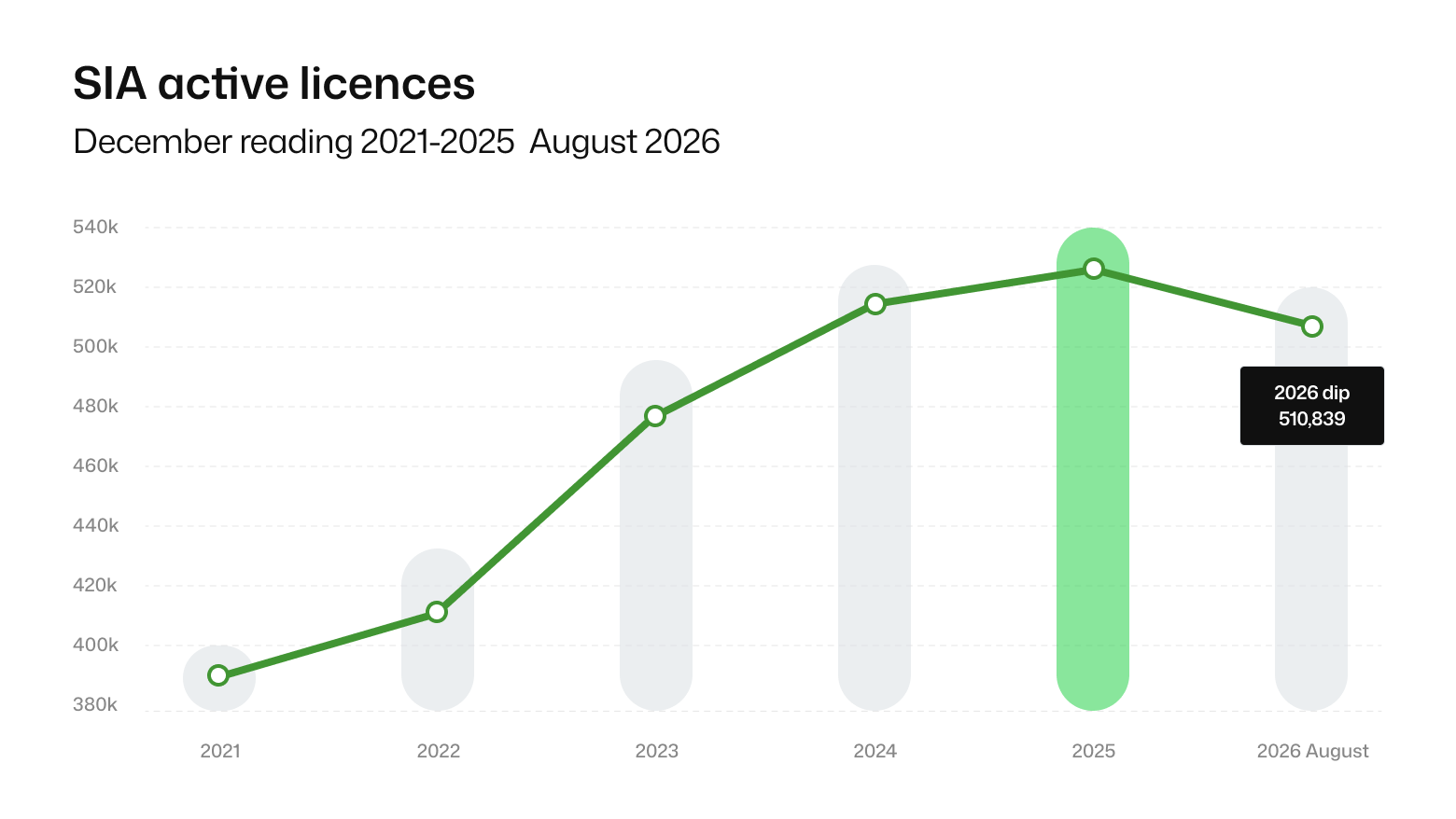
Source: SIA licence statistics, official data files.24 Axis starts at 380,000. The 2026 dip tracks a 16% fall in first-time applications during 2025.95
Active SIA licences, August 2026, held by 450,364 people. Median age 37; 30% under 30.
SIA, official22Median full-time annual pay for security guards, April 2025. The advertised frontline median is £13.33 an hour.
ASHE 20256; GL Pay Index96Premises acquiring statutory protect duties under Martyn's Law, expected in force from spring 2027, regulated by the SIA.
Home Office impact assessment25Annual staff turnover reported for the security sector, against 38% across the private sector. Churn is demand: leavers must be replaced.
Industry benchmark, secondary97The projection, with the working shown
A projection is only as good as its stated assumptions. These are the three used below. Low: the 2025 dip in new applications persists and the line drifts to about 505,000. Central: growth resumes at 2.5% a year, roughly half the recorded 2020 to 2025 rate, reaching about 541,000 by end 2028. High: the recorded compound rate of 4.6% a year returns as Martyn's Law duties land, reaching about 567,000. If AI automates the CCTV slice faster than expected, the low path captures it.
Where the line goes next
Recorded series to August 2026, then the three scenarios as a band. The central path is drawn.
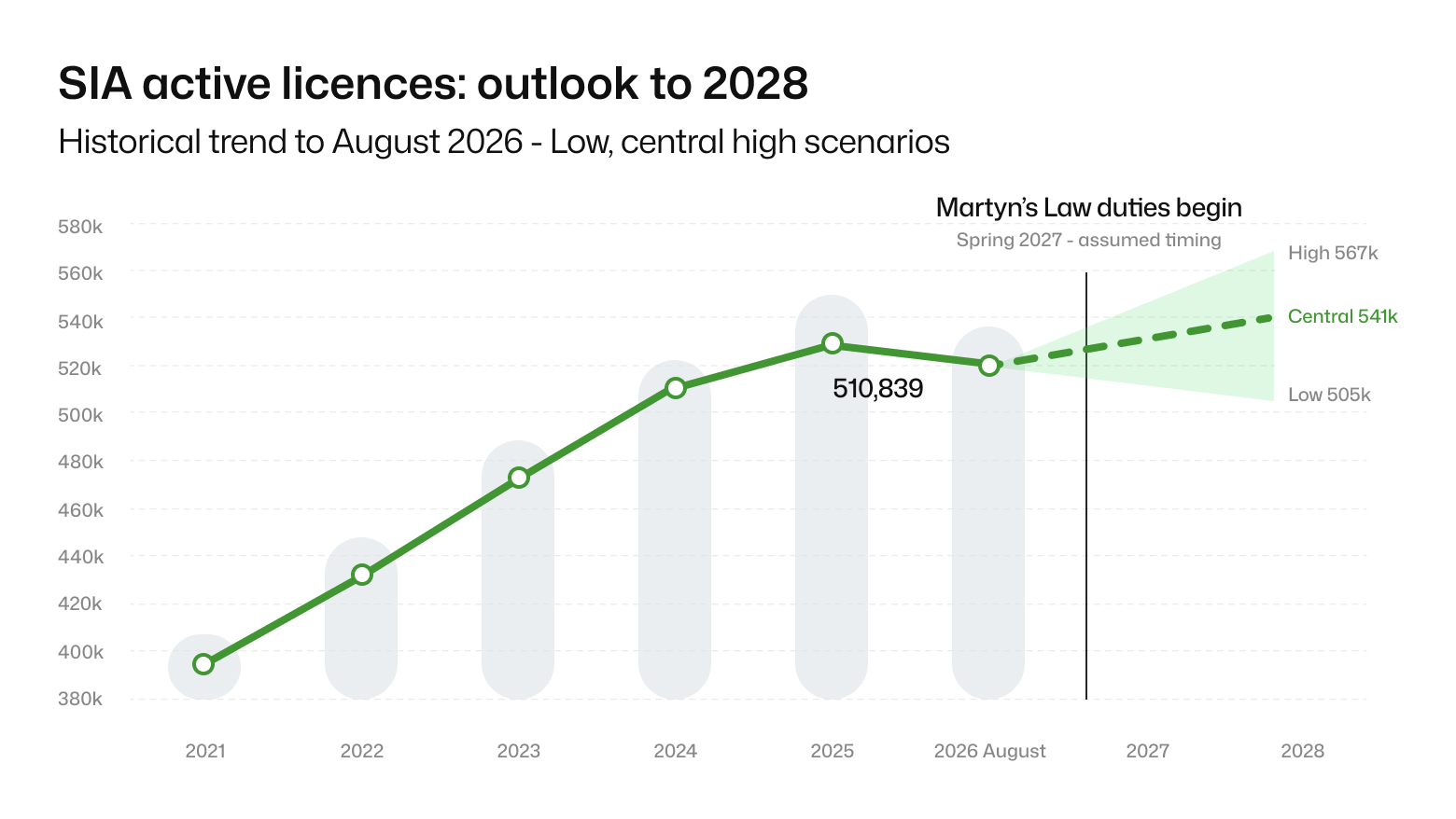
Projection by Get Licensed Research from the SIA series.24 Assumptions stated above; this is a reasoned range, and it carries no more authority than its inputs.
Why the central and high paths are more likely than the low one: Martyn's Law is a statutory demand floor arriving on a known date28; the police gap and retail crime push private demand upward2693; and replacement churn alone generates tens of thousands of openings a year regardless of net growth.94 Why the low path stays on the chart: 2025 applications fell 16%, and the exposed CCTV slice is real. An honest chart shows the whole range.
Security demand has a statutory floor from spring 2027 and a five-year record of growth. The reasoned range for end 2028 is 505,000 to 567,000 active licences, with the balance of drivers pointing to the upper half.
Chapter 10
Where to move
For a person on the exposed rungs, the question is practical: which door, what does it cost, what does it pay. The principle first, then the doors. Move towards work with a licence, a presence, or accountability attached. Learn to run the machines, and keep the tasks they cannot do.
The pay case for moving
Median full-time annual pay, April 2025. Dark bars are exposed desk roles. Green bars are the protected destinations.
Source: ASHE 2025 provisional.6 Employees only. Self-employed trade earnings sit above these figures.
From customer service · £28,036
↓ move to
Security officer · £33,832
The skills transfer directly: reading people, staying calm, handling conflict in words. Median full-time pay is £5,800 higher.
Route: licence-linked training takes about a week, then the SIA licence application. Working within weeks.47
From retail · £25,056
↓ move to
Retail security · £13.60/hr advertised
Same shop floor, protected side of it. Retailers spent £5.5 billion on crime prevention in five years while shop violence runs at 3.5 times 2019 levels.14
Route: door supervision or security guarding licence; retail security is the second-largest advertised security role.96
From admin and book-keeping · £28,294
↓ move to
The AI-operations seat in your own firm
Every firm automating its admin needs people who run, check and correct the machines. AI skills carry a 56% average wage premium.4
Route: free government short courses now exist for exactly this.13 Become the person who operates the system that replaced the task.
From a stalled graduate search
↓ move to
Electrician apprenticeship · £39,647 at median
140 applications chase each graduate vacancy.48 The electrician gap is 104,000 by 2032, the largest of any trade, and median full-time pay beats the national median.29
Route: a four-year apprenticeship, earning throughout. Security work is a common way to earn while applying.
From driving and operative work · £33,835
↓ move to
Plumbing and heating · £37,881
73,700 more plumbers needed by 2032; the heat pump target needs nine times the 2022 installer base by 2028.3132
Route: adult retraining courses and apprenticeships; gas work needs Gas Safe registration.33
From any exposed desk role
↓ move to
Stay, and own the machine
Staying can be the right move. Older, experienced workers in exposed occupations held their ground in the US data; the doors closed on new entrants.7 Experience plus AI fluency is the strongest desk position there is.
Route: be the one who tests the tools, sets the checks, and owns the output. The 56% premium is paid for that seat.4
Pay figures are medians for full-time employees, April 2025.6 Advertised hourly rates for security are live Get Licensed Pay Index readings from real adverts.96 Hourly and annual figures answer different questions; both are shown where they exist.
The protected ground is open
Get Licensed has been training security professionals since 2007. Licence-linked training runs every week across the UK, and the demand evidence is the chapter you just read.
Book a security courseChapter 11
The government plan
There is a funded government plan for AI. It is a plan for adoption and skills. For workers displaced by AI there is no dedicated programme, and this chapter shows exactly what exists instead.
AI Opportunities Action Plan
All 50 recommendations accepted: 20x public compute by 2030, AI Growth Zones, a National Data Library.98
TechFirst, £187 million
School, undergraduate and PhD AI skills; an industry pledge to train 7.5 million workers by 2030.99
AI Skills Boost
Free short courses for all adults; target raised to 10 million workers trained by 2030; one million completions recorded.13
The government's own exposure assessment
DSIT and the AI Security Institute publish the 70% exposure figure and the 32% displacement-risk cohort, with the caveat that causality is unproven.12
Early Careers Jobs Alliance, £20 million
Maps how entry-level work is changing; AI bootcamp pilots for school leavers; a 2027 jobs-guarantee pilot in the North East.100
Parliament examines the gap
The Business and Trade Committee runs an inquiry into AI and the future of the workforce. The Bank of England governor warns publicly about entry-level roles and the talent pipeline.101
The direct answer
Does the UK have a funded plan for workers whose jobs AI removes? No. The funded programmes train people in AI skills and help young people enter work. There is no statutory transition duty, no displacement fund, and no employment-service programme specific to AI displacement. The chancellor's stated goal is the opposite direction of travel: the fastest AI adoption in the G7, with an OECD estimate that AI could add 0.4 to 1.3 percentage points to UK productivity growth each year over the decade.102
One country has built the thing the UK has yet to build. Singapore gives every citizen aged 40 and over a S$4,000 retraining credit, a training allowance of up to 24 months, and up to 90% fee subsidies on approved courses.103 An individual entitlement that follows the worker through a transition. The UK think-tank estimates of displacement, one to three million jobs over the coming years on the central Tony Blair Institute view, up to eight million in IPPR's worst case, are exactly the scale such a scheme exists for.104105
The practical reading for a worker: the state will fund your course. It will not fund your transition. The moves in chapter 10 are self-service.
The government plan funds adoption and courses. Displacement is being studied, and it is unfunded. Workers should plan on that basis.
Chapter 12
The next 24 months
How this unfolds through 2027 and 2028, stated as three scenarios with the evidence that would confirm each, and the six numbers to watch.
Three things are locked in regardless of scenario. The compute is committed: hundreds of billions of dollars of capacity lands through 2028.6970 The capability trend has run at a doubling every four to seven months for years.66 And the robots stay slow: the physical trades' protection holds through this window on every credible timeline.76
| Scenario | What happens to jobs | What you would see first |
|---|---|---|
| Slower The sceptics are right89 | Productivity gains stay modest. Hiring freezes thaw. The entry-level squeeze eases but the trades gaps remain. | Graduate vacancies recover through 2027; the Bank Underground gradient flattens. |
| Central The current data extends | The freeze spreads up the ladder by attrition. Entry-level desk hiring stays shut, organisations compress without mass redundancy, protected demand grows. | Youth unemployment stays high while total unemployment barely moves; SIA licences climb toward the central path. |
| Faster The lab warnings land106 | Up to half of entry-level white-collar roles gone within one to five years on the strongest stated warning; unemployment reaches levels that force a displacement policy. | Visible redundancy waves in professional services; a displacement fund enters the Budget debate. |
The mechanism to expect in every scenario is the one already measured: doors close before anyone is pushed through them. Hiring slows first, headcount falls by attrition, and the people affected are the ones who never got in.7
Six numbers that settle the argument as they land
| Watch | Where | What it tells you |
|---|---|---|
| UK vacancies, monthly | ONS Vacancy Survey91 | The overall temperature of hiring. |
| Entry-level and graduate postings | Adzuna and Indeed reports19 | The leading edge of the reshuffle. |
| Adverts by AI exposure | Bank Underground updates8 | Whether the gradient steepens or flattens. |
| The government's annual assessment | DSIT and AI Security Institute12 | The official displacement-risk cohort, updated. |
| SIA active licences, monthly | SIA statistics24 | The security line against chapter 9's range. |
| Martyn's Law commencement | Home Office28 | The statutory demand floor's exact start date. |
The fuel is committed, the gradient is visible, and the robots stay slow. Expect the central path: a quiet reshuffle through hiring, compressing organisations from the middle, with the protected ground growing underneath.
Straight answers
Questions people actually ask
AI takes tasks, and a job is a bundle of tasks. Whether your job goes depends on how many of its tasks the machine can do, whether demand for the output grows when it gets cheaper, and whether law or physical presence requires a person. Chapters 4 and 8 give the test; the ladder in chapter 6 gives the ranking. If you are early-career in desk work, the risk is real now, and it arrives as doors that fail to open. The move list in chapter 10 exists for exactly that case.
The watching is automating; the standing is protected. AI already helps monitor video, and that slice of the industry, 13.2% of licences, is genuinely exposed. The licensed person at the door is protected three ways: robots lack the dexterity and judgement for unpredictable physical work, the law requires a licensed human for front-line duties, and from spring 2027 Martyn's Law adds statutory duties across 178,900 premises. The recorded demand line grew 25% in five years.
For medicine, engineering and work with statutory registration, yes. For a general degree aimed at a generic office job, the maths has changed: 140 applications per graduate vacancy, intakes cut at the biggest graduate employers, and the exposure studies put clerical professional work at the top of the risk table. A trade apprenticeship now pays above the national median at the electrician's rate, with a six-figure worker gap behind it. The honest answer is: check what the specific degree buys, against what the specific trade pays.
The data says the opposite. Experienced workers in exposed occupations held their ground in the US payroll data; the squeeze is on new entrants. That gives you time, and two live options: become the person in your firm who runs the AI, or take the licence route into protected work, where the security workforce already has a median age of 37 and takes career changers every week.
Three actions. First, test your own job against chapter 8's three walls: physical unpredictability, licence, presence. Second, learn the tools doing your tasks; the free government courses exist and the AI-skills premium is 56%. Third, if you are on the top rungs of the ladder, price a move: a week of licence-linked training opens security; an apprenticeship opens the trades. Start now.
Every claim traced
Sources
Numbered in order of first citation. Official statistics and primary documents throughout; where a figure rests on press reporting or a company claim, the chapter says so in the text.
- Department for Education, The impact of AI on UK jobs and training, 28 November 2023. The security guards passage is at page 15. gov.uk
- World Economic Forum, Future of Jobs Report 2025 (170m created, 92m displaced, net +78m by 2030; security guards in the largest-declining list). reports.weforum.org
- City AM, Big Four slash graduate jobs as AI takes on entry-level work, 23 June 2025 (reported figures; KPMG 1,399 to 942). cityam.com
- PwC, Global AI Jobs Barometer 2025 (productivity growth 7% to 27%; 56% wage premium; close to a billion job ads), 3 June 2025. pwc.com
- ONS Annual Population Survey via Nomis, employment by SOC 2020 occupation, Apr 2025 to Mar 2026 (API extract, reproducible). nomisweb.co.uk
- ONS, Annual Survey of Hours and Earnings, Table 14 (occupation by SOC 2020), 2025 provisional, released 23 October 2025. ons.gov.uk
- Brynjolfsson, Chandar and Chen, Canaries in the Coal Mine? Six facts about the recent employment effects of AI, Stanford Digital Economy Lab, 2025 (US ADP payroll data). digitaleconomy.stanford.edu
- Bank of England staff blog (Bank Underground), Canaries in the column? AI exposure and the UK's hiring slowdown, 6 August 2026. The author cautions that attribution to AI remains premature. bankunderground.co.uk
- ONS, Occupations of those in employment by age and sex, England and Wales, Census 2021 (31 May 2023). Under-30 and over-50 shares derived from the published five-year bands. ons.gov.uk
- Fortune, Klarna hires humans again after AI quality admission, 9 May 2025. fortune.com
- CNBC, Salesforce CEO confirms support cuts from ~9,000 to ~5,000 with Agentforce, 2 September 2025. cnbc.com
- DSIT and AI Security Institute, Assessment of AI capabilities and the impact on the UK labour market, 28 January 2026. gov.uk
- gov.uk, AI Skills Boost: free AI training, target of 10 million workers by 2030, 28 January 2026. gov.uk
- British Retail Consortium, Crime Report 2026 (violence ~1,600 a day, ~3.5x pre-pandemic; £5.5bn spent on prevention over five years). brc.org.uk
- Entrepreneur, IBM CEO: AI replaced a few hundred HR roles, total employment up, May 2025. entrepreneur.com
- Anthropic Economic Index, first report (57% augmentation v 43% automation; usage peaks in mid-to-high wage occupations), 10 February 2025. anthropic.com
- Tomlinson, Jaffe, Wang, Counts and Suri, Working with AI: measuring the occupational implications of generative AI (arXiv 2507.07935), Microsoft Research, July 2025. arxiv.org
- Stanford Digital Economy Lab, Canaries update: the early-career gap widened to about 19% by June 2026, August 2026. digitaleconomy.stanford.edu
- Adzuna, UK Job Market Report, May 2026 (graduate vacancies -42.1% year on year; trade and construction +26.6%). adzuna.co.uk
- ITBrief, UK government to cut back-office roles and target £2bn+ annual savings with AI, March 2025. itbrief.co.uk
- Anthropic Economic Index, September 2025 report (enterprise API usage ~77% automation patterns). anthropic.com
- SIA, licence holder statistics, August 2026 official data file (510,839 active licences; 450,364 holders; sector split; ages). assets.publishing.service.gov.uk
- Private Security Industry Act 2001, legislation.gov.uk. legislation.gov.uk
- SIA, licence holders statistical data set, gov.uk (monthly official series from December 2020; December figures used for the annual line). gov.uk
- Home Office, Terrorism (Protection of Premises) Bill impact assessment, signed 11 September 2024 (178,900 premises in scope). assets.publishing.service.gov.uk
- Home Office, Police workforce, England and Wales, 31 March 2026 (145,886 officers; total workforce 4.1% below March 2010). gov.uk
- McKinsey Global Institute, A future that works: automation, employment and productivity (predictable physical ~81% automatable, unpredictable ~25%), January 2017. mckinsey.com
- gov.uk collection, Terrorism (Protection of Premises) Act 2025 (Royal Assent 3 April 2025; implementation at least 24 months). gov.uk
- UK Trade Skills Index 2023 (electricians: 104,000 needed by 2032), via Electrical Times. electricaltimes.co.uk
- Approved Document P (electrical safety, dwellings), Building Regulations, Planning Portal. planningportal.co.uk
- CIPHE, UK Trade Skills Index 2023 (plumbers: 73,700 needed by 2032). ciphe.org.uk
- Nesta, The heat pump installer gap (about 3,000 engineers in 2022; at least 27,000 needed by 2028). nesta.org.uk
- Gas Safety (Installation and Use) Regulations 1998, legislation.gov.uk. legislation.gov.uk
- CITB, Construction Workforce Outlook 2025 to 2029: 239,300 extra workers needed by 2029. citb.co.uk
- ONS, The probability of automation in England: 2011 and 2017, March 2019 (70.2% of high-risk jobs held by women). ons.gov.uk
- PwC UK Economic Outlook (March 2017): transportation and storage the highest-risk UK sector for automation (56% of jobs by the early 2030s), arriving in the late "autonomy wave". pwc.co.uk
- House of Commons Transport Committee, Self-driving vehicles (2023): SMMT evidence that vehicles average about 14 years on the road, so most of the UK fleet stays human-driven for decades; the committee asked government for a strategy for the future of human driving. publications.parliament.uk
- Wayve, TfL grants private-hire licences for the Uber and Wayve London autonomy trial (safety driver on board), August 2026. wayve.ai
- Waymo, London announcement, October 2025; autonomous testing with safety operators from April 2026. waymo.com
- Department for Transport, self-driving vehicle pilots fast-tracked to spring 2026; government claims a £42bn industry and 38,000 jobs by 2035 (a creation claim; no displacement assessment has been published), 10 June 2025. gov.uk
- Department for Transport, Taxi and private hire vehicle statistics, England 2026: 417,300 driver licences at 1 April 2026, up 9% on 2024. Licences, and never a headcount. gov.uk
- Uber BV v Aslam [2021] UKSC 5: Supreme Court ruled Uber drivers are workers, entitled to the minimum wage and paid leave, 19 February 2021. en.wikipedia.org
- Binns et al. (University of Oxford), longitudinal study of 1.5 million UK Uber trips: after algorithmic pricing, driver compensation fell and pay became less predictable (arXiv 2506.15278), June 2025. arxiv.org
- CIPD, The gig economy: what does it really look like? (strict definition: about 463,600 people, 1.4% of the workforce, from unpublished ONS Labour Force Survey data), September 2023. cipd.org
- TUC and University of Hertfordshire, platform work survey: 4.4 million people (14.7% of working adults) in England and Wales did platform work at least weekly in 2021, up from 5.8% in 2016. Published November 2021. tuc.org.uk
- Employment Rights Act 2025 (Royal Assent 18 December 2025): guaranteed-hours offers for zero and low-hours workers, with main duties expected from 2027. Employment status itself was left unreformed. en.wikipedia.org
- gov.uk, Find out if you need an SIA licence. gov.uk
- Institute of Student Employers, Student Recruitment Survey 2025 (hiring -8%; 140 applications per vacancy). ise.org.uk
- Startups.co.uk reporting Adzuna data: UK entry-level vacancies down 32% since ChatGPT launched, 16 July 2025. startups.co.uk
- Youth Employment UK, labour market statistics summary of ONS data (16.2%, 739,000, Apr to Jun 2026). youthemployment.org.uk
- AIPRM search-volume study via Ahrefs, reported by Forbes and FutureCIO (January to February 2025): the most-searched "Will AI replace...?" roles globally are programmers, software developers, accountants, lawyers and data analysts. forbes.com
- King's College London (2026): 69% of UK workers worried about AI job losses; own-job risk highest in administrative and secretarial (43%) and sales and customer service (41%) occupations, lowest in skilled trades (20%) and caring (18%). kcl.ac.uk
- ONS, Labour market overview, UK: August 2026 (employment series MGRZ; 34,469,000 in work, Apr to Jun 2026). ons.gov.uk
- OpenAI, Introducing ChatGPT, 30 November 2022. openai.com
- OpenAI, GPT-4 research page, 14 March 2023. openai.com
- OpenAI, Learning to reason with LLMs (o1), September 2024. openai.com
- Anthropic, upgraded Claude 3.5 models and computer use, 22 October 2024. anthropic.com
- DeepSeek, R1 release, 20 January 2025. api-docs.deepseek.com
- OpenAI, Introducing GPT-5, 7 August 2025. openai.com
- Anthropic, Claude Opus 4.5 (SWE-bench Verified 80.9%), 24 November 2025. anthropic.com
- Google, Gemini 3 (GPQA Diamond 91.9%), 18 November 2025. blog.google
- Anthropic, Claude Fable 5 and Claude Mythos 5, June 2026. anthropic.com
- Jimenez et al., SWE-bench (arXiv 2310.06770), October 2023; scores for later models from the announcement pages cited alongside. arxiv.org
- Rein et al., GPQA: a graduate-level Google-proof Q&A benchmark (arXiv 2311.12022), November 2023. PhD experts score about 65% overall. arxiv.org
- Epoch AI, LLM inference price trends: GPQA-equivalent capability fell from $37.50 to $0.12 per million tokens in 21 months, 12 March 2025. epoch.ai
- METR, Measuring AI ability to complete long tasks (doubling every ~7 months), 19 March 2025. metr.org
- METR, time horizons page (frontier ~12-hour horizon; doubling time ~4 months over 2024-25), updated May 2026. metr.org
- OpenAI, GDPval: measuring model performance on real economically valuable tasks, 25 September 2025. openai.com
- OpenAI, Five new Stargate sites ($400bn+ committed, ~7GW), 23 September 2025. openai.com
- Anthropic, $50 billion investment in American AI infrastructure, 12 November 2025. anthropic.com
- Dario Amodei, The Adolescence of Technology, 26 January 2026. darioamodei.com
- Axios, Demis Hassabis on AGI around 2029-2030, 26 May 2026. axios.com
- Moravec's paradox: overview and original sources. en.wikipedia.org
- Electrek, Tesla Optimus production status (zero robots in useful factory work, January 2026 admission), 22 April 2026. electrek.co
- Figure, Ramping Figure 03 production (350+ delivered), 2026. figure.ai
- Rodney Brooks, Why today's humanoids won't learn dexterity, 26 September 2025. rodneybrooks.com
- Frey and Osborne, The Future of Employment, Oxford Martin School, September 2013. oxfordmartin.ox.ac.uk
- Georgieff and Milanez, What happened to jobs at high risk of automation?, OECD working paper 255, May 2021 (abstract quoted verbatim). oecd.org
- Resolution Foundation and LSE, Economy 2030: technology has not been the predicted job-destroying wave, 10 November 2022. resolutionfoundation.org
- Amazon, CEO Andy Jassy message on generative AI, 17 June 2025 (primary source). aboutamazon.com
- CNN, Amazon confirms about 14,000 corporate job cuts, 28 October 2025. cnn.com
- CNN, BT to cut up to 55,000 jobs by 2030, around 10,000 replaced by AI, 18 May 2023. cnn.com
- The Register, BT chief says AI could allow deeper cuts, 16 June 2025. theregister.com
- Klarna, AI assistant handles two thirds of customer service chats in its first month (company claim), 27 February 2024. klarna.com
- Bloomberg, IBM to pause hiring for back-office jobs AI could do (~7,800 roles), 1 May 2023. bloomberg.com
- Statista, share of UK employers expecting AI to change headcount, 2025 (survey data, secondary). statista.com
- IMF, Gen-AI: artificial intelligence and the future of work, staff discussion note SDN/2024/001, 14 January 2024. imf.org
- Goldman Sachs, Generative AI could raise global GDP by 7% (300 million full-time jobs exposed), 2023. goldmansachs.com
- Acemoglu, The simple macroeconomics of AI, NBER working paper 32487 (at most ~0.66% TFP over ten years), May 2024. nber.org
- Microsoft Research, Applicability versus job displacement: further notes, 21 August 2025 (quoted verbatim). microsoft.com
- ONS, Vacancies and jobs in the UK: August 2026 (707,000, May to July 2026; peak 1,294,000 in spring 2022, series AP2Y). ons.gov.uk
- Big Issue reporting ONS NEET estimates: 1.01 million 16 to 24 year olds, January to March 2026. bigissue.com
- British Retail Consortium, Crime Survey 2025 (violence and abuse over 2,000 incidents a day; £4.2bn cost). brc.org.uk
- US Bureau of Labor Statistics, Occupational Outlook Handbook, security guards (about 157,200 openings a year, 2025 to 2035; US proxy). bls.gov
- Coredinate, reporting SIA first-time licence applications down 16% in 2025 (secondary presentation of SIA data). coredinate.de
- Get Licensed Pay Index: live index of advertised UK security pay built on real Adzuna adverts (715 adverts, 31 July to 27 August 2026). First-party data. gl-pay-index.vercel.app
- RBS Mentor, UK staff turnover benchmarks by industry (security 50.8% in 2023; secondary source, labelled as such). rbsmentor.co.uk
- gov.uk, AI Opportunities Action Plan (Matt Clifford; all 50 recommendations accepted), 13 January 2025. gov.uk
- gov.uk, TechFirst: £187 million national skills programme, 8 June 2025. gov.uk
- gov.uk, Early Careers Jobs Alliance, AI bootcamps and tech training (DSIT and DWP), 6 June 2026. gov.uk
- Insurance Journal, reporting Andrew Bailey's BBC Radio 4 interview on AI and displacement, 19 December 2025. insurancejournal.com
- gov.uk, Chancellor Rachel Reeves' speech at the AI Adoption Summit (fastest adopter in the G7; OECD 0.4 to 1.3pp estimate), 8 June 2026. gov.uk
- Singapore Ministry of Education, SkillsFuture Level-Up Programme (S$4,000 credit aged 40+; training allowance up to 24 months), 4 March 2024. moe.gov.sg
- Tony Blair Institute, The impact of AI on the labour market (1 to 3 million UK private-sector jobs displaced cumulatively; peak 60,000 to 275,000 a year), November 2024. institute.global
- IPPR, Up to 8 million UK jobs at risk from AI unless government acts (worst case 7.9 million), 27 March 2024. ippr.org
- Axios, Dario Amodei: AI could eliminate up to 50% of entry-level white-collar jobs within one to five years, 28 May 2025. axios.com


Find work, try mock tests and book courses from
the UK's #1 app for security professionals