Trustpilot
POPULAR COURSES


Download GuardPass App


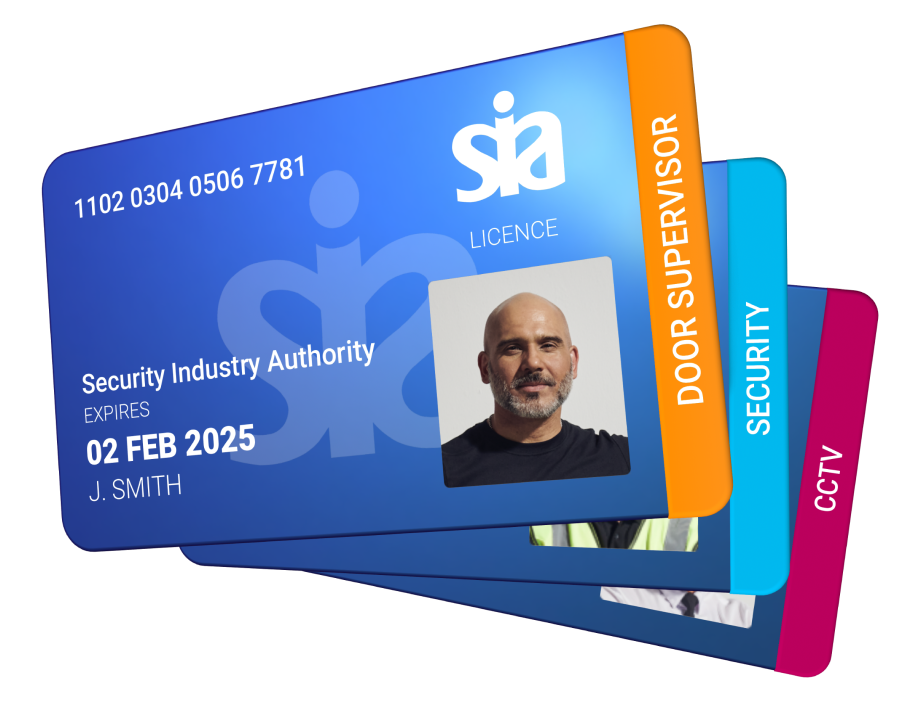

On the Frontline: A Report on Workplace Violence in the UK

by Get Licensed | Mar 10, 2026 | Reading Time: 10 mins

Workplace violence across the UK is rising, but the workforce most exposed to it remains almost entirely absent from the data. Security professionals stand at the centre of aggression in hospitals, shopping centres, bars, and stadiums, yet their experiences are rarely captured in the national conversation about worker safety.
To address that gap, Get Licensed surveyed over 500 frontline security professionals about the violence they face and the violence they witness being directed at other workers. What emerged is a detailed, ground-level account of a workforce under siege — and a wider crisis of workplace violence that stretches across nearly every sector in Britain. Combined with the latest national data from the HSE, NHS, BRC, and other leading bodies, this report offers one of the most comprehensive pictures of frontline violence in the UK today.
Who We Surveyed
Our survey captured insights from 537 security professionals across the UK, providing a robust and detailed picture of the modern security industry. The majority of respondents (87%) are currently working in the sector, with a significant number holding a Door Supervisor licence (87%). They work across a diverse range of environments, with the top sectors being the night-time economy (45%), events (40%), and retail (35%).
Key Findings
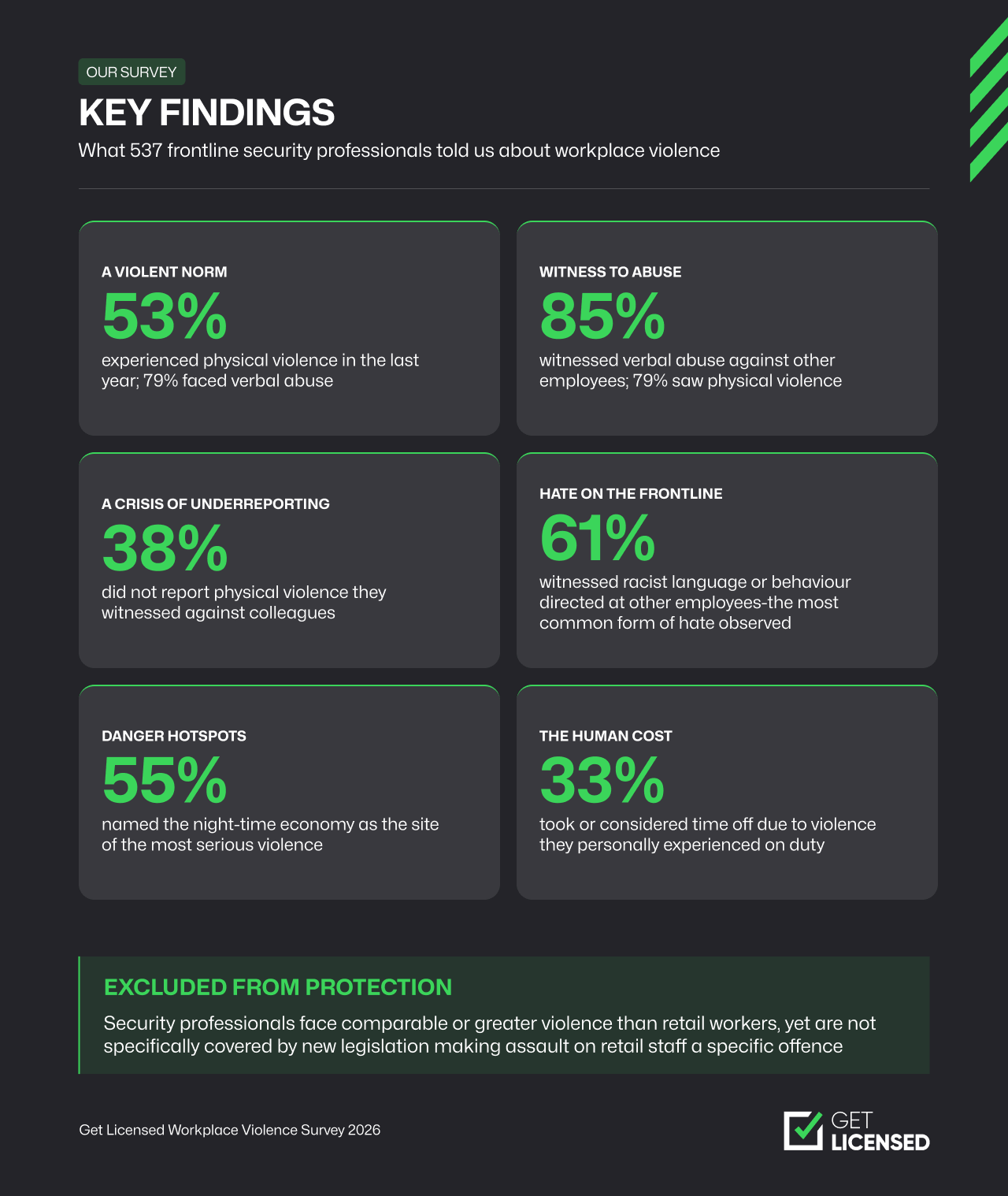
- A violent norm: Over half (53%) of security professionals experienced physical violence in the last year, while 79% faced verbal abuse.
- Witness to abuse: The vast majority of officers witnessed violence against other employees, with (79%) seeing physical violence and 85% seeing verbal abuse.
- A crisis of underreporting: Violence is consistently underreported. While most officers who experience violence do report it, a significant number of witnessed incidents are not. 38% of officers did not report physical violence they saw directed at colleagues.
- Hate on the frontline: 61% of officers witnessed racist language or behaviour directed at other employees, making it the most common form of discriminatory abuse observed. Violence was most frequently directed at men (65%) and women 42%.
- Danger hotspots: The night-time economy and retail remain the most violent sectors, with 55% of officers naming the night-time economy as the site of the most serious violence.
- The human cost: Nearly a third 33% of security staff took or considered time off due to violence they personally experienced, mirroring research that shows high levels of PTSD among security operatives. [1]
- Excluded from protection: Security professionals are not specifically covered by new legislation that makes assaulting a retail worker a specific offence, despite facing comparable or greater risks. [2]
The Scale of the Threat: Violence Against Security Professionals
The data from our survey of 537 security professionals paints a stark picture of the daily reality for the UK's security workforce. These professionals are not just passive observers; they are frequently the direct targets of aggression and hostility. The findings underscore that violence is not an occasional hazard but a routine part of the job for a significant majority of the security workforce.
A Constant Barrage of Abuse
Our survey reveals that an alarming 79% of security professionals have experienced verbal violence while on duty in the last 12 months. This is not low-level rudeness; it is aggressive, often threatening, language that creates a hostile and intimidating work environment.
The frequency is relentless. For 40% of respondents, facing aggressive or threatening behaviour is a daily or weekly reality. In total, 85% of security professionals have to handle aggression at least once a year, making it a near-universal part of the job.
Physical violence is also shockingly prevalent. Over half (53%) of security officers reported being physically assaulted in the past year. These are not minor scuffles; they are serious assaults that put the safety and lives of security professionals at risk.
| Type of Violence Experienced (Last 12 Months) | Percentage of Respondents |
|---|---|
| Verbal Violence | 79.3% |
| Physical Violence | 53.3% |
These figures from the frontline are a microcosm of a national problem. The Health and Safety Executive (HSE) estimates there were 689,000 incidents of violence at work in 2024/25, with protective service occupations facing the highest risk rate of any profession at 7%—seven times the national average. [3] This confirms that security professionals are disproportionately affected by workplace violence compared to the general working population.
The Silence of Underreporting
Despite the high prevalence of violence, a concerning number of incidents go unreported. While our survey shows that the majority of officers who personally experience violence do report it (92% for physical and 81% for verbal), the picture changes when it comes to witnessed events. A significant 38% of officers who witnessed physical violence against a colleague did not report it, and 33% stayed silent about verbal abuse they saw.
This reluctance to report can stem from a variety of factors. Some may feel that it is simply ‘part of the job,’ a sentiment echoed in research with other frontline professions like teaching. [8] Others may lack faith in the reporting process, fearing they won’t be taken seriously or that it will lead to negative repercussions for their career. This culture of underreporting masks the true scale of the problem and prevents employers and authorities from taking effective action.
A Shared Risk: Violence Across the Frontline
Security professionals are not the only ones in the line of fire. Their unique position gives them a direct view of the abuse and aggression faced by employees in every sector, from retail and hospitality to healthcare and education. Our survey data reveals that witnessing violence against other staff is an almost universal experience for security officers, highlighting a shared vulnerability across all frontline roles.
Witness to the Daily Grind
The vast majority of security officers are witnessing violence against other employees with alarming regularity. 85% of our respondents witnessed verbal violence directed at other staff members, with 44% stating this happens "very frequently." The situation is just as concerning for physical violence, with 79% of security officers having witnessed an assault on another employee.
| Violence Witnessed Against Other Employees | Percentage of Respondents |
|---|---|
| Witnessed Verbal Violence | 84.5% |
| Witnessed Physical Violence | 78.6% |
When these incidents occur, security staff are often compelled to step in. Over half (52%) of officers reported intervening in physical violence against other employees, and 67% stepped in to de-escalate verbal confrontations. This places them in a difficult position, having to manage a volatile situation while ensuring the safety of themselves and others.
Sector Spotlights: A National Crisis
The experiences of our surveyed security officers reflect a nationwide crisis of violence against frontline workers. Here’s a closer look at what’s happening in the key sectors identified in our report:
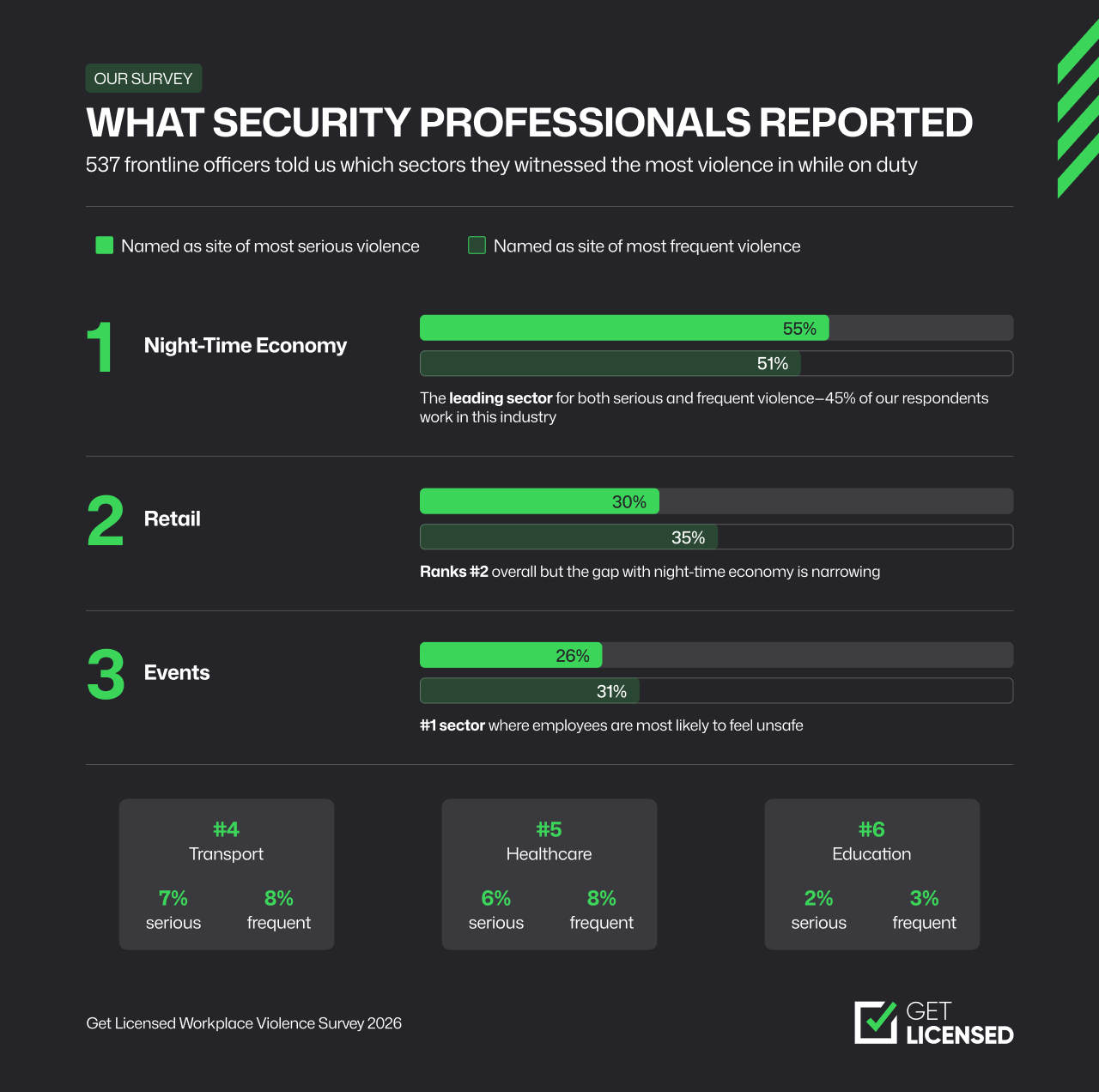
Night-Time Economy: he undisputed hotspot for serious violence in our survey (55% of respondents). The mix of alcohol and large crowds creates a volatile environment where, according to a 2022 survey, one-third of night-time economy workers have experienced unwanted behaviour, with female staff being disproportionately affected. [11]
Retail: Identified by our respondents as the second most violent sector, retail is facing an epidemic of abuse. The British Retail Consortium reported over 2,000 incidents of violence and abuse per day in the year to January 2025, a staggering 340% increase since 2020. Confronting thieves is a major trigger for this violence and abuse. [5]
Events: Ranking third for both frequent (31%) and serious (26%) violence, the events sector is another major hotspot. Large crowds, high emotions, and often alcohol create a volatile mix. It is also the sector where employees are most likely to feel unsafe, according to our survey.
Healthcare: Healthcare emerges as a significant area of concern in our survey. This is backed by shocking NHS data showing 1 in 7 staff experienced physical violence in 2024. [4] Additionally, patient violence is at an all-time high, with 285 incidents reported each day on average. [10] The British Medical Association has highlighted that this can lead to staff questioning their competence and confidence, potentially taking a toll on workforce numbers. [9]
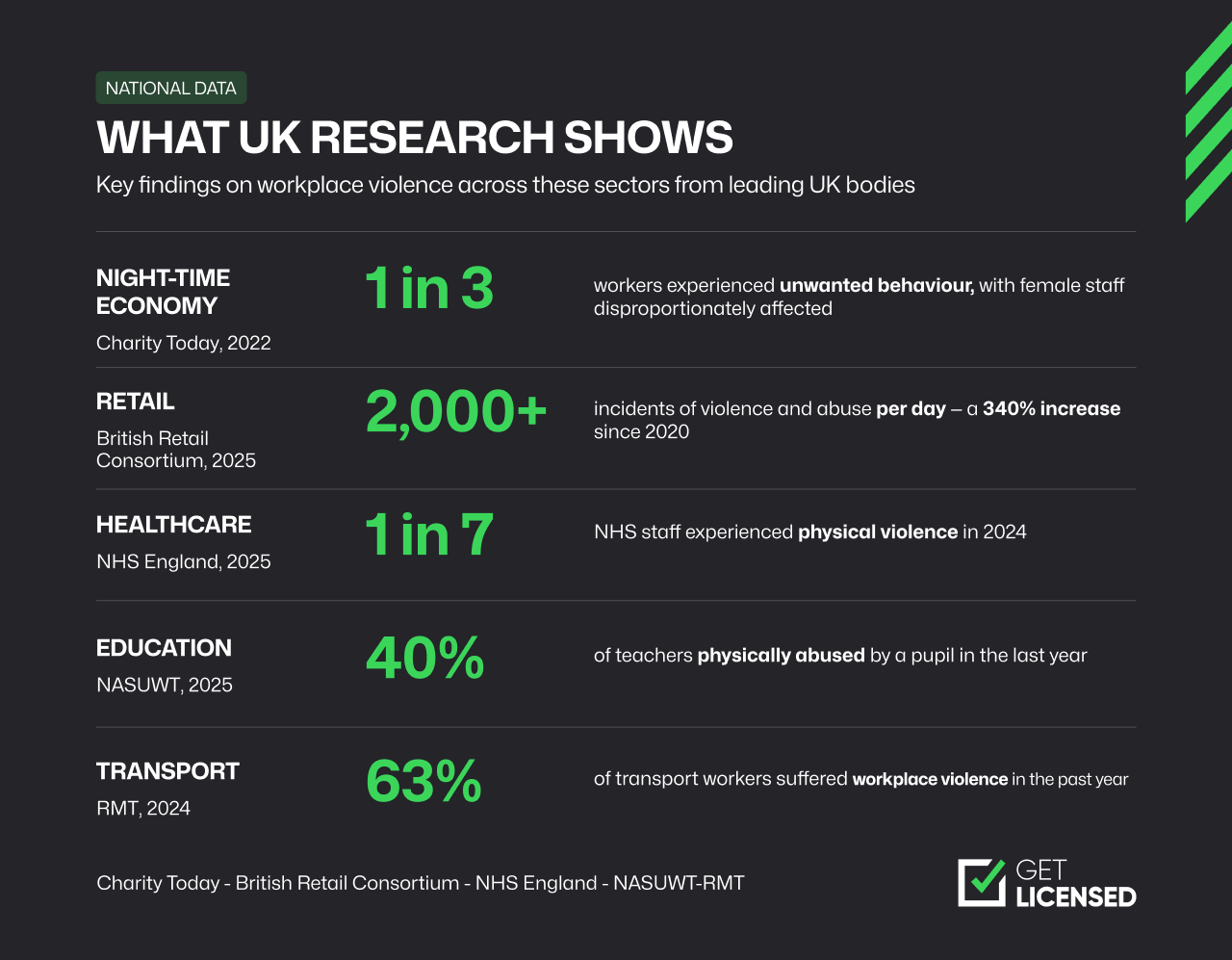
Education: While less frequent in our survey, violence in schools is a severe and growing problem. A 2025 NASUWT survey found that 40% of teachers had been physically abused by a pupil in the last year, and 85% had suffered verbal abuse. [8] Many teachers reported a culture where such behaviour is treated as ‘part of the job’.
Transport: Our survey placed transport in the top five sectors for serious violence. This is consistent with data from the RMT union, which found that 63% of transport workers suffered workplace violence in the past year, with a 47% rise in serious offences on the rail network between 2021 and 2024. [12] Lone workers are particularly at risk.
The Nature of the Attack: A Spotlight on Discrimination
Workplace violence is rarely random; it is often targeted and fueled by prejudice. Our survey asked security professionals to identify the groups most frequently subjected to the violence they witnessed being directed at other employees.
The responses reveal a disturbing pattern of abuse directed at individuals based on their gender, race, and perceived vulnerability. This highlights that much of the aggression frontline workers face is not just a reaction to a situation but a manifestation of deeper societal biases.
Who is Being Targeted?
According to the security officers we surveyed, the violence they witness is overwhelmingly directed at men (65%) and women (42%). The high figure for men likely reflects the composition of the workforce in high-risk sectors like the night-time economy and retail, where male employees and customers are frequently involved in confrontations.
The figure for women is particularly concerning in the context of ongoing national conversations around Violence Against Women and Girls (VAWG), and suggests that female employees across sectors face a significant and persistent threat of aggression in the workplace.
Beyond gender, however, the data reveals that violence is also frequently targeted at individuals based on their race, age, and perceived vulnerability. Racial and ethnic minorities were identified as targets by over a fifth of respondents, while young people and migrants also featured prominently.
| Other Groups Frequently Targeted by Witnessed Violence | Percentage of Respondents Who’ve Witnessed Violence |
|---|---|
| Racial or ethnic minorities | 21.8% |
| Young people (under 25) | 16.6% |
| Migrants/people with limited English | 14.9% |
| Older people (over 65) | 8.9% |
| LGBTQ+ individuals | 8.8% |
| Transgender individuals | 8.8% |
| Religious minorities | 8.2% |
| Disabled people | 4.7% |
| Non-binary individuals | 4.5% |
| Other | 6.0% |
A further 12% of respondents said they were "not sure" which groups were most targeted, which may reflect the chaotic and fast-moving nature of many violent incidents. The breadth of this list underscores a troubling reality: workplace violence does not discriminate in who it targets, but the motivations behind it very often do.
An Epidemic of Hate
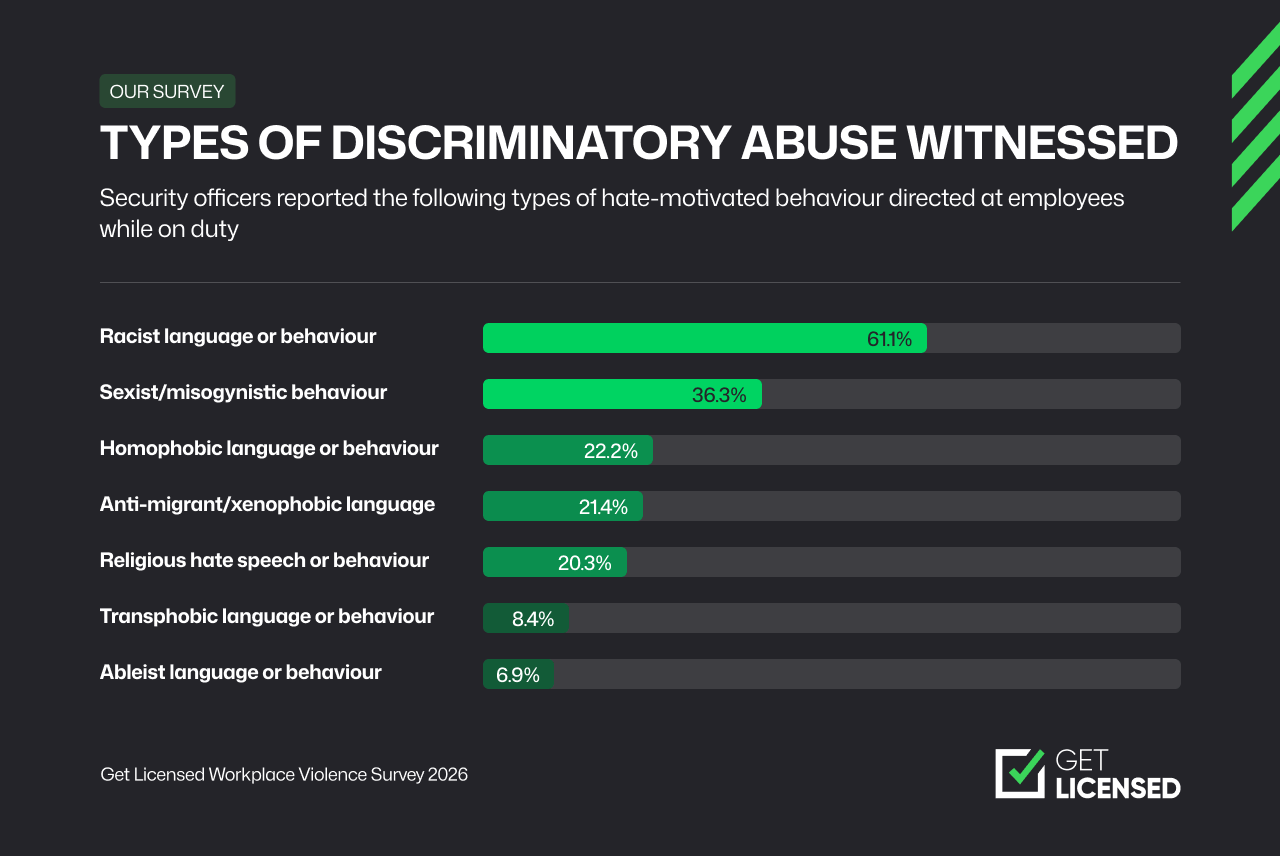
The discriminatory nature of this violence is made even clearer when looking at the types of abuse witnessed. An overwhelming 61% of security professionals have witnessed racist language or behaviour directed at other employees, making it the most common form of discriminatory abuse observed. This is a stark reminder that for many frontline workers, racial abuse is a grim part of their daily working life.
| Type of Discriminatory Abuse Witnessed | Percentage of Respondents |
|---|---|
| Racist language or behaviour | 61.1% |
| Sexist/misogynistic behaviour | 36.3% |
| Homophobic language or behaviour | 22.2% |
| Anti-migrant/xenophobic language | 21.4% |
| Religious hate speech or behaviour | 20.3% |
| Transphobic language or behaviour | 8.4% |
| Ableist language or behaviour | 6.9% |
These findings demonstrate that the frontline of our public spaces is also the frontline in the fight against hate and intolerance.
This data provides a powerful, ground-level view of the abuse that is often hidden from statistics. It shows that for many workers, the threat is not just physical, but is also an attack on their identity and dignity.
The Human Cost: A Workforce at Breaking Point
The constant exposure to violence and aggression has a profound and lasting impact on the mental and physical health of frontline workers. The effects are not just fleeting moments of fear or stress; they can lead to significant psychological distress, burnout, and a desire to leave the profession. Our survey provides a window into this hidden cost of workplace violence, a cost that is corroborated by extensive academic and industry research.
The Toll on Mental Health
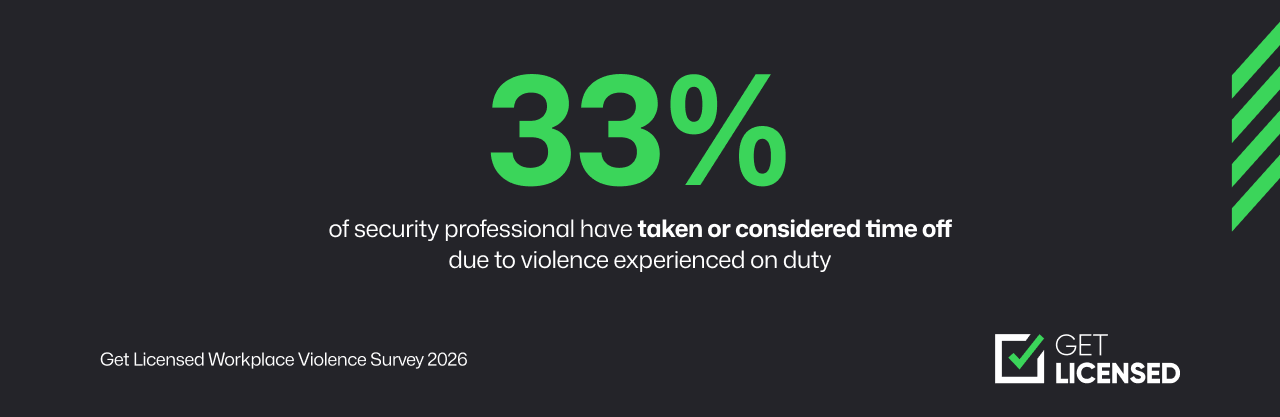
The pressure is taking its toll. A significant 33% of security professionals surveyed have either taken time off work or considered doing so because of violence they personally experienced. When the scope is broadened to include violence witnessed against others, that figure stands at 26%. This indicates that a substantial portion of the workforce is struggling to cope with the psychological aftermath of their job.
These findings are tragically mirrored in a landmark 2020 study by the University of Portsmouth, which found that nearly 40% of UK security operatives were exhibiting symptoms of Post-Traumatic Stress Disorder (PTSD). [1]
The study’s author, Professor Mark Button, noted a “real lack of provision by security companies for employee mental health and wellbeing services,” a sentiment echoed by the Security Industry Federation’s “Behind the Uniform” report, which highlights the burnout, fatigue, and vulnerability caused by isolation and routine abuse. [6]
You can read more about this in our blog on mental health in the security industry.
| Impact of Violence on Security Professionals (Our Survey) | Percentage of Respondents |
|---|---|
| Took or considered time off due to personal violence | 32.6% |
| Took or considered time off due to witnessed violence | 25.7% |
A Pervasive Climate of Fear

The fear is palpable and extends to the entire workplace. 42% of the security officers we surveyed confirmed that other employees at their venues have expressed feeling unsafe due to the risk of violence.
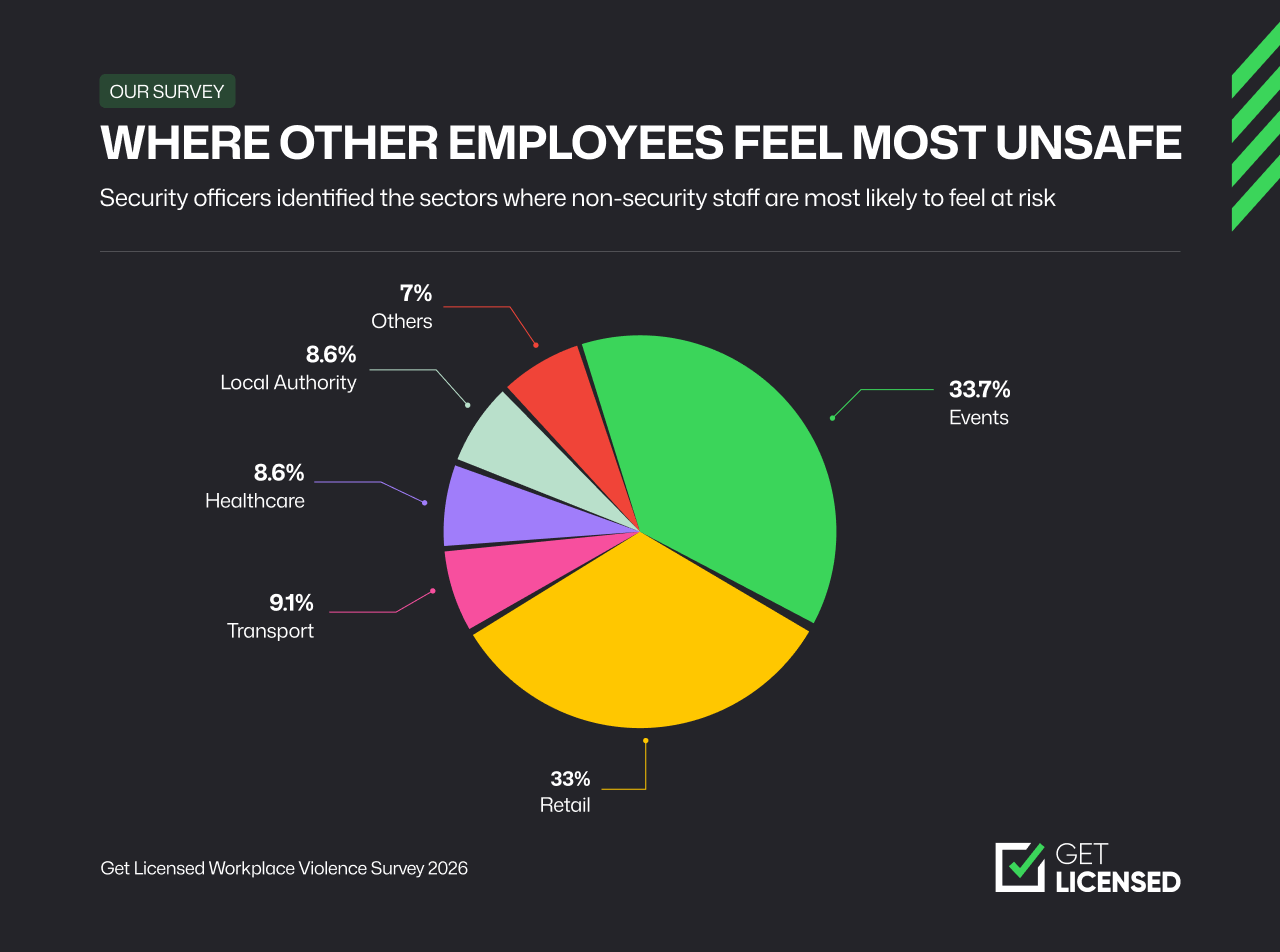
This creates a pervasive culture of anxiety that can damage morale, increase staff turnover, and ultimately impact business performance. Our survey asked security officers in which sectors they believed other employees felt most unsafe. Events (34%) and Retail (33%) topped the list, reinforcing where the climate of fear is most acute.
As research from Acas shows, workplace conflict comes with a staggering annual cost of £28.5 billion to the UK economy, driven by absences and resignations. [7]
| Top Sectors Where Other Employees Feel Unsafe | Percentage of Respondents |
|---|---|
| 1. Events | 33.7% |
| 2. Retail | 33.0% |
| 3. Transport | 9.1% |
| 4. Healthcare | 8.6% |
| 5. Local Authority | 8.6% |
What This Means and What Needs to Change
The data in this report tells a clear story: workplace violence is widespread, underreported, and taking a serious toll on the people who face it every day. But data alone does not drive change. What follows is a look at what these findings demand: from the industry, from employers, and from policymakers.
The Changing Role of Security Officers
The officers in this report are not passive bystanders. Over half (52%) intervened in physical violence against other employees. Two-thirds (67%) de-escalated verbal confrontations. This is trained, professional conflict resolution carried out daily across every sector this report covers.
This is why Get Licensed's SIA training programmes place conflict management and de-escalation at the core of every course.
Closing The Gaps
This report exposes three failures that demand a response:
A Reporting Crisis
38% of officers who witnessed physical violence against a colleague did not report it. When violence goes unrecorded, employers cannot act, and the true scale stays hidden. Reporting systems must be accessible, non-punitive, and taken seriously.
A Protection Gap
New legislation makes assaulting a retail worker a specific offence, and yet, security professionals, who face comparable or greater violence, are not specifically covered. The people tasked with protecting frontline workers deserve frontline protections themselves.
A Mental Health Crisis in Plain Sight
A third of officers took or considered time off due to violence. Research puts PTSD rates among UK security operatives at nearly 40%.
Employers must invest in mental health and well-being provision as seriously as they invest in operational capability.

A Safer Frontline Starts Here
At Get Licensed, we train thousands of security professionals every year at 85+ SIA training centres across the UK, equipping them with the skills this report shows are needed most. We also help individuals get their SIA licences and step into frontline roles, such as door supervisors working at licensed night-time premises, security guards in static guarding roles, or CCTV operators working in control rooms.
But training is only part of the answer. This is a call to employers, policymakers, and the industry: close the gaps, and protect the people who protect everyone else.
Methodology
This report is based on a survey of 537 security professionals conducted by Get Licensed in January and February 2026. The survey was distributed via email to individuals who have recently trained with Get Licensed and have been a part of the security industry. The data was analysed to identify key trends and patterns in the experiences of workplace violence. All percentages have been rounded to the nearest whole number or one decimal place. The findings from the survey are supported by secondary data from credible UK-based sources, including the Health and Safety Executive (HSE), NHS England, the British Retail Consortium (BRC), and academic institutions.
References
[1] University of Portsmouth. (2020). Security guards struggle with PTSD and lack mental health support.
[2] UK Government. (2025). Crime and Policing Bill: Retail Crime Factsheet.
[3] Health and Safety Executive. (2025). Violence at work statistics.
[4] NHS England. (2025). Frontline NHS staff facing rise in physical violence.
[5] British Retail Consortium. (2025). BRC Retail Crime Survey 2025.
[7] Acas. (2021). Estimating the costs of workplace conflict.
[8] NASUWT. (2025). Better Deal on Behaviour.
[9] British Medical Association. (2024). The effects of workplace violence.
[12] RMT. (2025). Over 75% of transport workers ready to take industrial action.


Find work, try mock tests and book courses from
the UK’s #1 app for security professionals



Get Licensed helps you get SIA trained, licensed, and ready for real security jobs — trusted by 450,000+ people across the UK.
Copyright © 2026 | All rights reserved