Trustpilot
POPULAR COURSES


Download GuardPass App



The Security Worker Standards Gap: Insights into PPE, Preparation, and Industry Practices

by Get Licensed | Jun 22, 2026 | Reading Time: 15 mins
The defining reality of frontline security work in 2026 is the gap between the risks workers face and the standards they are provided.
Our survey of 271 SIA-licensed security professionals reveals a workforce that routinely encounters verbal abuse, physical assault, and the threat of weapons — yet operates without consistent access to professional-grade protective equipment, without legal parity with other frontline workers, and without an industry-wide framework for ongoing development. More striking still, where workers have asked their employers for protection, the majority have been refused.
What workers themselves are telling us is not a list of grievances. It is a coherent vision for what professional standards in UK security should look like.
Key Findings
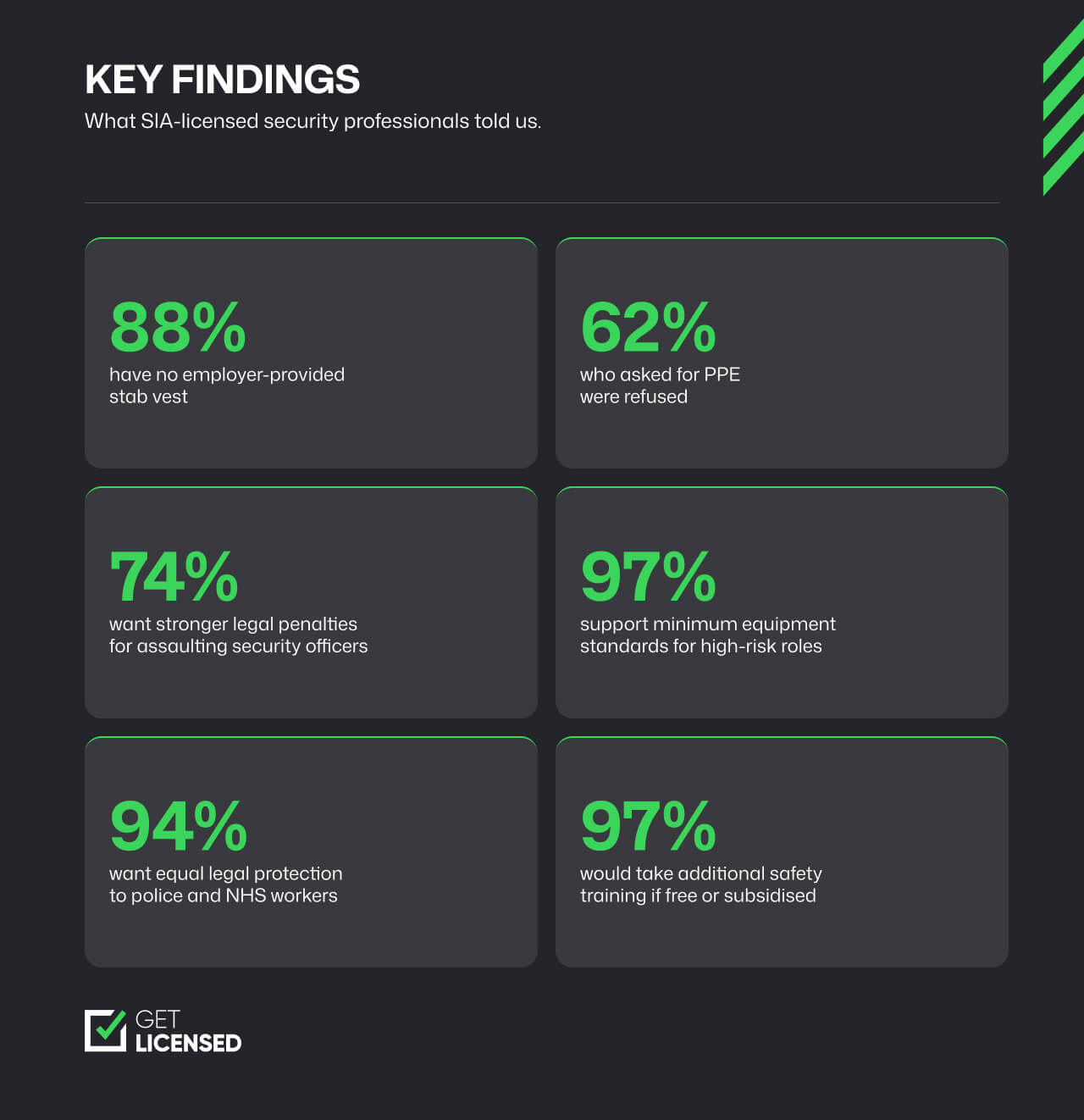
From our pool of 271 security officers:
- 88% of security workers do not have an employer-provided stab vest, despite 31% being physically assaulted on duty in the last 12 months and 19% threatened with a weapon.
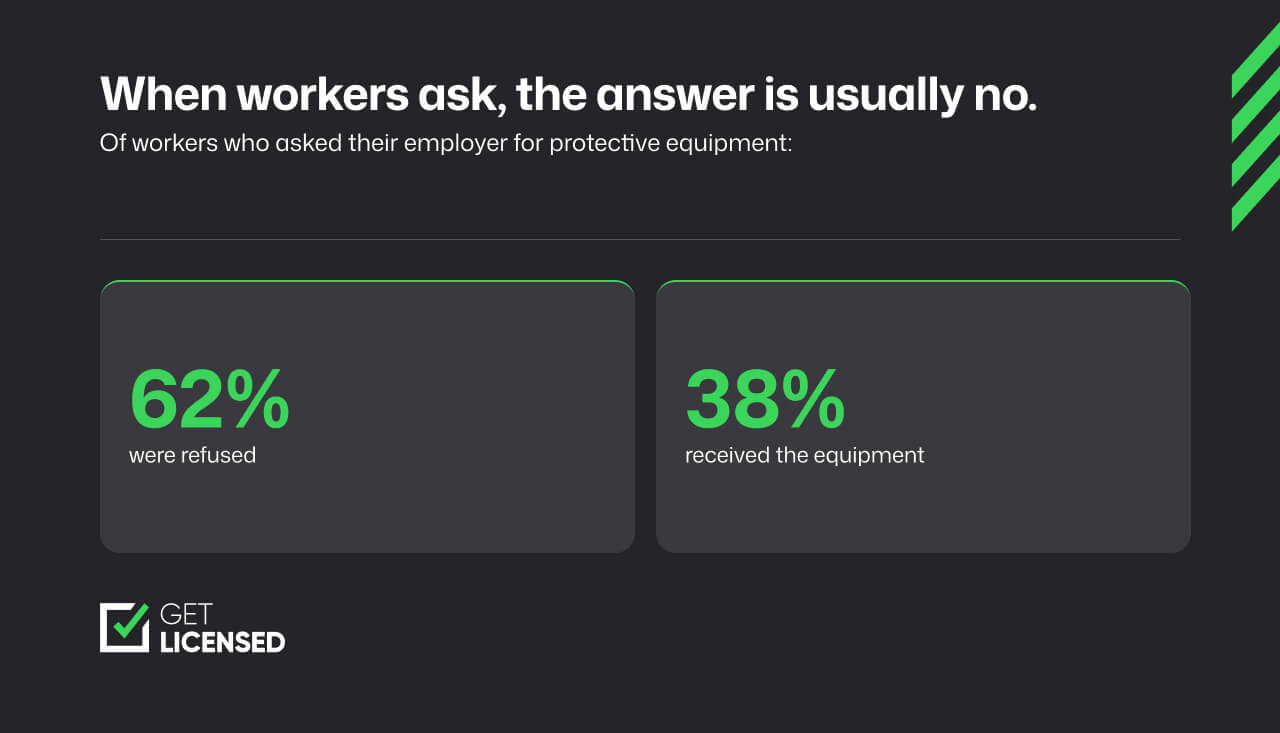
- 62% of security workers who have asked their employer for protective equipment have been refused. Only 31 of 81 requests resulted in equipment being provided.
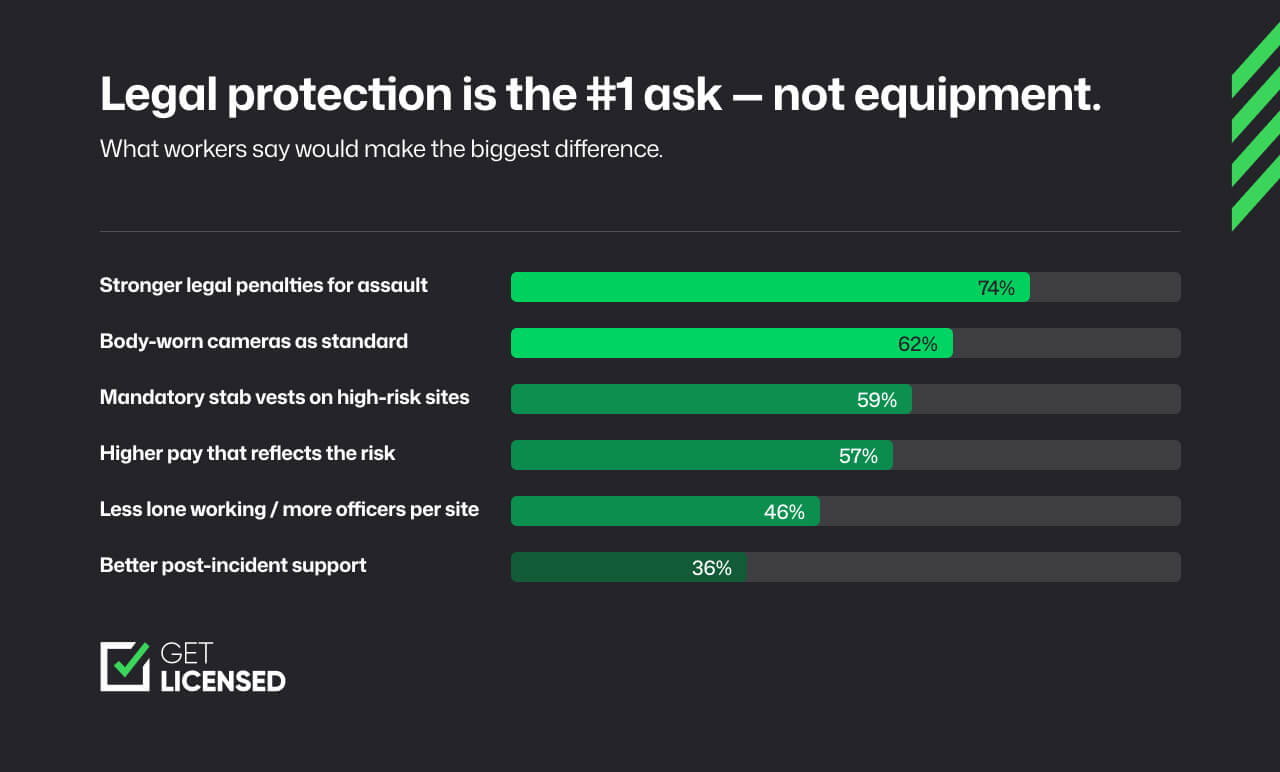
- A majority of security officers support stronger legal penalties for assaulting security officers as the single most important change required — backed by 74% of respondents, ahead of body-worn cameras (62%) and stab vests (59%).
- 97% of security officers support some form of minimum equipment standard for high-risk roles, with 83% wanting that standard to be mandatory and SIA-enforced.
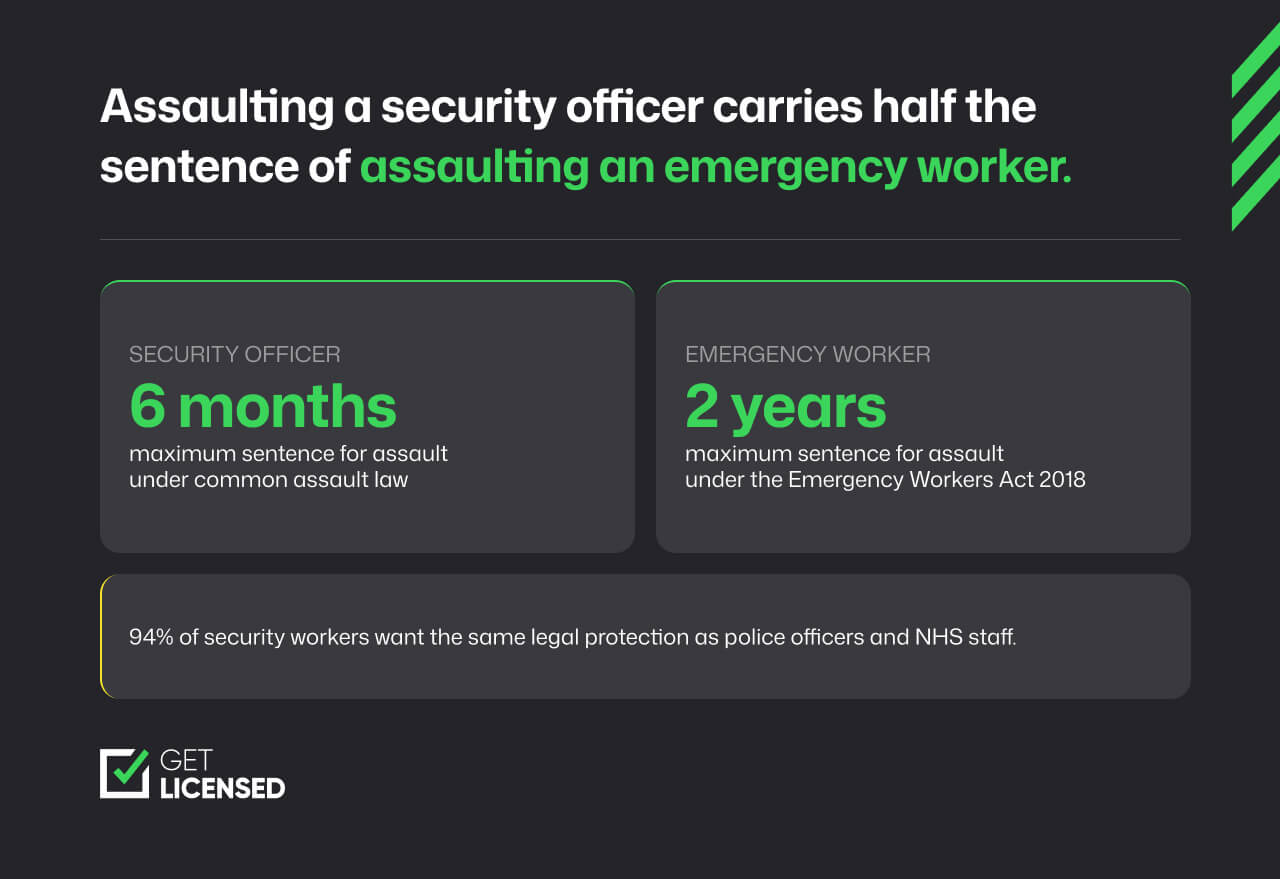
- 94% of security officers want legal protection equivalent to police and NHS workers under the Assaults on Emergency Workers Act 2018.
- 97% of security officers would take up additional safety training if subsidised or free, suggesting strong demand for professionalisation beyond baseline SIA requirements.
This report sets out what those numbers mean — and what needs to change.
Who We Surveyed
Get Licensed surveyed 271 SIA-licensed security professionals across the UK in April–May 2026. The survey was distributed through Get Licensed's network of past learners and active industry contacts.
| Characteristic | Detail |
|---|---|
| Total respondents | 271 |
| Currently working in security | 91% (247 respondents). The remaining 9% (24 respondents) hold licences but are not currently active in a security role. |
| Licence held (any) | 85% Door Supervisor; 22% CCTV Operator; 17% Security Guard; 2% Close Protection. Many hold more than one. |
| Experience | Modal category: 1–3 years (29%). Median respondent falls in the 3–7 year band. 20% have more than 15 years' service. |
| Region | London 24%; East Midlands 11%; South East England 11%; North West 10%; South West 9%. All UK nations and English regions represented. |
| Primary role | Corporate/officer security 23%; door supervision 20%; retail security 14%; event security 13%; mobile patrol, CCTV, management, and specialist roles making up the remainder. |
| Lone working | 30% always or mostly work alone on a typical shift. |
This profile gives the survey both breadth (every UK region, multiple sectors, full experience range) and a deliberate focus on the SIA-licensed workforce that is closest to the operational realities the report describes.
The Equipment Gap
What Employers Actually Provide
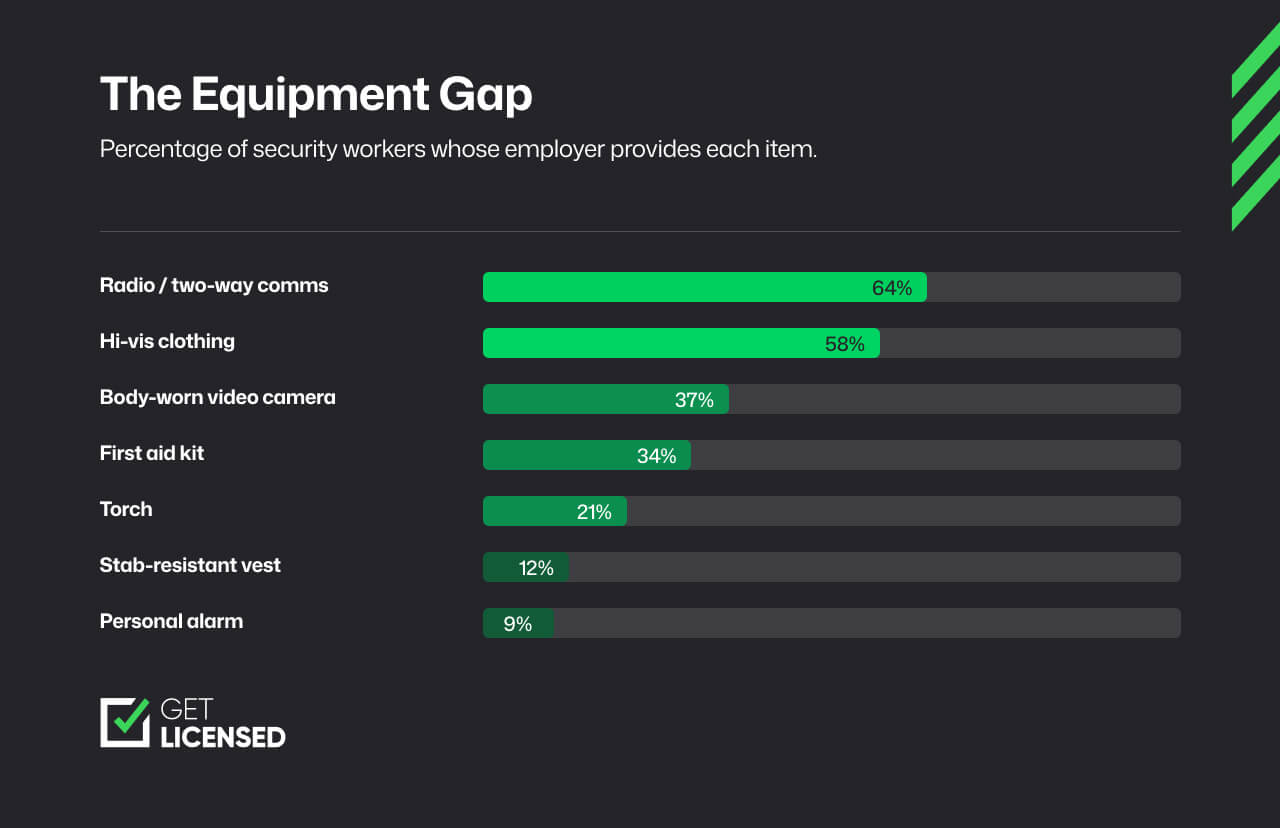
When asked what protective and operational equipment their employers currently provide, respondents reported a clear pattern: communication and visibility kit is relatively common, but protective body armour is rare.
| Item provided by employer | Share of respondents |
|---|---|
| Radio / two-way communication | 64% |
| Hi-vis clothing | 58% |
| Body-worn video camera (BWV) | 37% |
| First aid kit | 34% |
| Torch | 21% |
| Stab-resistant vest / body armour | 12% |
| Personal alarm or panic device | 9% |
| None of the above | 11% |
A further 19% of respondents told us they provide their own protective equipment out of pocket because their employer does not.
The headline is unambiguous: 88% of security workers lack an employer-provided stab vest, even though almost a third have been physically assaulted on duty in the last year, and one in five has been threatened with a weapon.
Asking and Being Refused
The equipment gap is not simply a question of supply. It is a question of employer response. Of the 81 respondents who told us they had asked their employer to provide protective equipment such as a stab vest or BWV:
- 50 were refused (62% of those who asked) — 31 with no reason given, 19 with a reason
- 31 had their request granted (38% of those who asked)
In other words, when a security worker on the front line asks for kit to protect themselves, the most likely outcome is a "no." This is the clearest indictment in the data of how the industry currently approaches worker safety, and it sits underneath the headline 88% provision gap.
Worker Consensus on Standards
When asked whether the SIA should mandate minimum PPE standards for high-risk roles:
- 83% said yes — make it mandatory and enforced
- 14% said yes — but as recommended guidance rather than mandatory
- 2% opposed any form of standard; the remainder were unsure
Combined, 97% of the respondents support some form of minimum equipment standard, and the supermajority of that group wants it to be mandatory rather than left to employer discretion. This is not advocacy by external parties. It is the people doing the work telling regulators what the floor should be.
"It should be mandatory for all companies or premises to issue body worn cameras, stab proof vests, high viz... We are on the front line but getting treated like mugs. Underpaid, while we put our lives at risk on a daily basis."
— Survey respondent, Door Supervisor
Risk Exposure
Security workers are not occasional bystanders to confrontation. They are positioned in it. According to the data collected from survey respondents, in the last 12 months:
- 72% have experienced verbal abuse or threats on duty. A third (34%) experience it at least monthly, and 15% encounter it on most shifts.
- 31% have been physically assaulted on duty — pushed, grabbed, punched, spat at, headbutted, or attacked with an object. Among workers holding a Door Supervisor licence, that figure rises to 33%.
- 19% have been threatened with a weapon — a knife, a bottle, a needle, or similar.
- 16% have been injured seriously enough to need medical attention or time off work.
This context matters because it frames every other finding in the report. Workers are not asking for equipment, training, or legal recognition in the abstract. They are asking for it in response to recurring, documented exposure.
By way of comparison, the Health and Safety Executive's Violence at Work 2024 to 25 statistics [1] identify protective service occupations — a category that includes police, prison officers, paramedics, and firefighters — as the highest-risk sector for workplace violence in the UK.
According to the HSE's latest data (combined 2023/24 and 2024/25), 7.7% of workers in protective service occupations experienced violence at work, compared to 1.1% across all occupations.
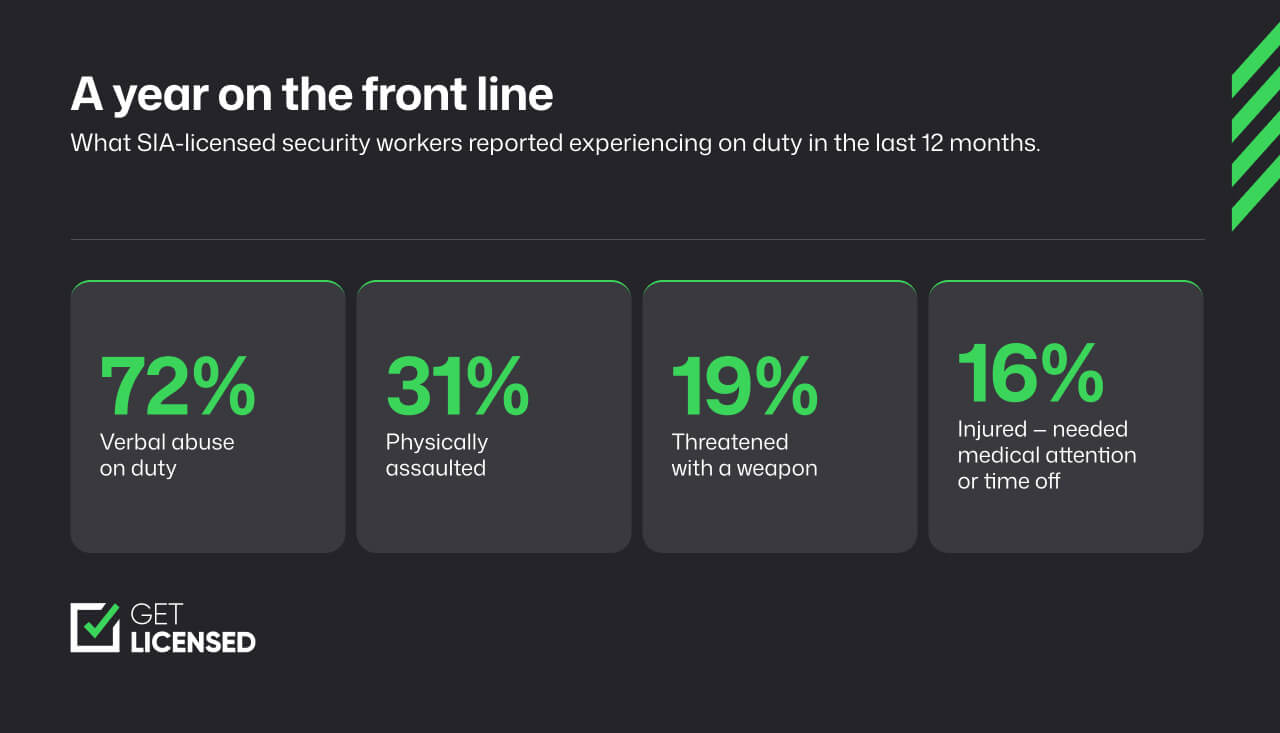
The security workers in this survey report notably higher rates of physical assault specifically: 31% have been physically assaulted on duty in the last 12 months, and 19% have been threatened with a weapon.
This suggests security workers may face elevated risk within the broader protective services category, though direct comparison is limited as the HSE figures combine assault and threat incidents.
Security workers are not separately broken out in the HSE figures, but the incident rates reported in this survey, particularly the 31% assault rate, indicate exposure on a comparable scale to other frontline protective roles. Our report on workplace violence in the UK provides additional context on violence across sectors.
What Workers Want
When asked what would make the biggest difference to their safety, respondents identified a clear and ranked set of priorities.
| Priority | Share of respondents selecting it |
|---|---|
| Stronger legal penalties for assaulting officers | 74% |
| Body-worn cameras as standard | 62% |
| Mandatory stab vests on high-risk sites | 59% |
| Higher pay that reflects the risk | 57% |
| Less lone working / more officers per site | 46% |
| Better post-incident support (mental health, welfare) | 36% |
Two findings warrant particular attention.
1. Legal Protection Ranks First
Above equipment, above staffing, above pay — the change workers most want is legal parity with the police and NHS staff they often work alongside. This is the data that directly underwrites the Stan's Law campaign [6] and the parliamentary petition currently before the government.
2. Higher Pay Is the Second-Most Cited Priority
It sits narrowly behind body-worn cameras and ahead of stab vests. This finding is rarely surfaced in industry discussion of professional standards. It should be. Workers are signalling that the gap between the risk profile of the job and the compensation it carries is itself a safety issue.
When wages fail to retain experienced staff, the people left on the door are less prepared, more often alone, and more often new to the role.
What This Means
The pattern across these six priorities is consistent. Workers are not asking for one fix. They are describing a package: legal recognition, equipment provision, fair compensation, and operational support. None of them stand alone.
Training and Professional Development
Baseline Training is Largely Working
The SIA licence is the foundational training requirement for UK security workers. Asked to rate how well their SIA training prepared them for dealing with violent or high-risk situations on a 1–5 scale:
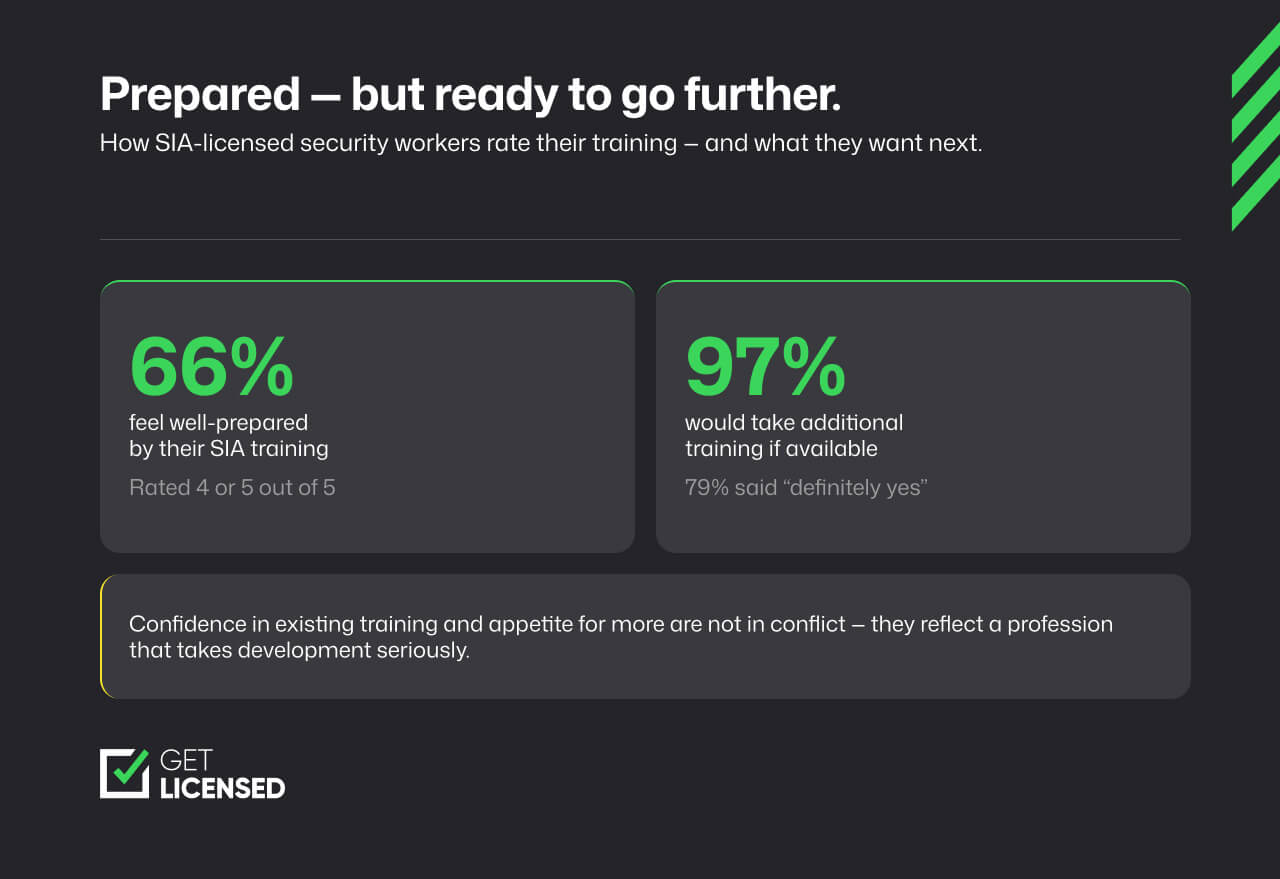
- 66% rated their preparation as good to excellent (4–5)
- 22% rated it as adequate (3)
- 12% rated it as poor (1–2)
Mean rating: 3.87. Median: 4.
The data supports the conclusion that the SIA framework — at its baseline — equips most workers with the conflict-management and situational awareness skills they encounter in practice.
Demand for Further Training Is Near-Universal
Despite that, the appetite for additional, specialised training is overwhelming.
- 79% would "definitely" take up further safety-related training if it were free or employer-subsidised
- 18% would "probably" take it up
- Combined: 97% are willing to undertake additional training
When asked what additional training they have already completed since their original SIA licence, the most common responses were:
- First aid at work (65%)
- Conflict management/de-escalation, advanced or refresher (46%)
- Physical intervention (40%)
- Mental health awareness/trauma response (35%)
- Body-worn video operation (27%)
- Lone worker safety (24%)
29% of respondents have done no additional security training since their original licence — most often because none has been offered or subsidised by their employer.
The signal is clear. Workers feel adequately prepared by baseline SIA training, and they want more. The current model — train once, qualify, and then rely on employer-led refreshers of varying quality — is not meeting their professional development needs.
A profession with this level of expressed appetite for ongoing development should have a framework to support it. Get Licensed's conflict management and mental health awareness resources explore how to build on baseline skills.
Legal Recognition and Stan's Law
The single largest area of worker consensus in this survey is on legal protection. Asked whether security officers should receive the same enhanced legal protection as police officers and NHS workers under the Assaults on Emergency Workers (Offences) Act 2018 [2]:
- 83% said "definitely yes"
- 11% said "probably yes"
- Combined: 94% support legal parity
- 3% were opposed; 3% were unsure
Currently, assaulting a security officer is treated, in legal terms, as common assault — carrying a maximum sentence of six months. Assaulting an emergency worker carries a maximum of two years, raised from twelve months under amendments made by the Police, Crime, Sentencing and Courts Act 2022 [3].
Workers are saying, clearly and at scale, that the law does not yet reflect the role they play. This consensus is what underpins Stan's Law, the campaign launched following the killing of Gary "Stan" Stanley, a 52-year-old security officer fatally stabbed on duty at centre:mk shopping centre in Milton Keynes on 28 February 2026.[7] The campaign calls for security workers to be brought under the same legal protections as emergency workers.
It also underpins parliamentary petition 750121 [5] — Make assaulting a security worker a standalone offence — created by Daniel Garnham, General Secretary of the Security Industry Federation, in December 2025.
On 30 April 2026, the Home Office responded. The response stopped short of committing to a new standalone offence, pointing instead to existing legislation: the statutory aggravating factor introduced under Section 156 of the Police, Crime, Sentencing and Courts Act 2022 for assaults on public-facing workers.
The response also referred to the new standalone offence of assaulting a retail worker contained in the Crime and Policing Bill (2025) [4], which covers retail security staff but not door supervisors, event security, or workers in other settings. The Home Office said it would "work with stakeholders to consider this matter further."
The petition closed on 9 June 2026 with a final total of 12,079 signatures. While it successfully passed the 10,000 threshold required to trigger a government response, it did not reach the 100,000 signatures required to be considered for parliamentary debate.
"To make strong penalties to a person who threatens a security officer — despite not being trained as police we nearly do the same job of protecting lives and property, but we are not protected, even our employers have no insurance."
— Survey respondent
Awareness of the Campaigns is Uneven
The case for Stan's Law and petition 750121 rests on a workforce that is, almost unanimously, in favour of the protections they seek. Worker awareness of the campaigns themselves, however, is more mixed:
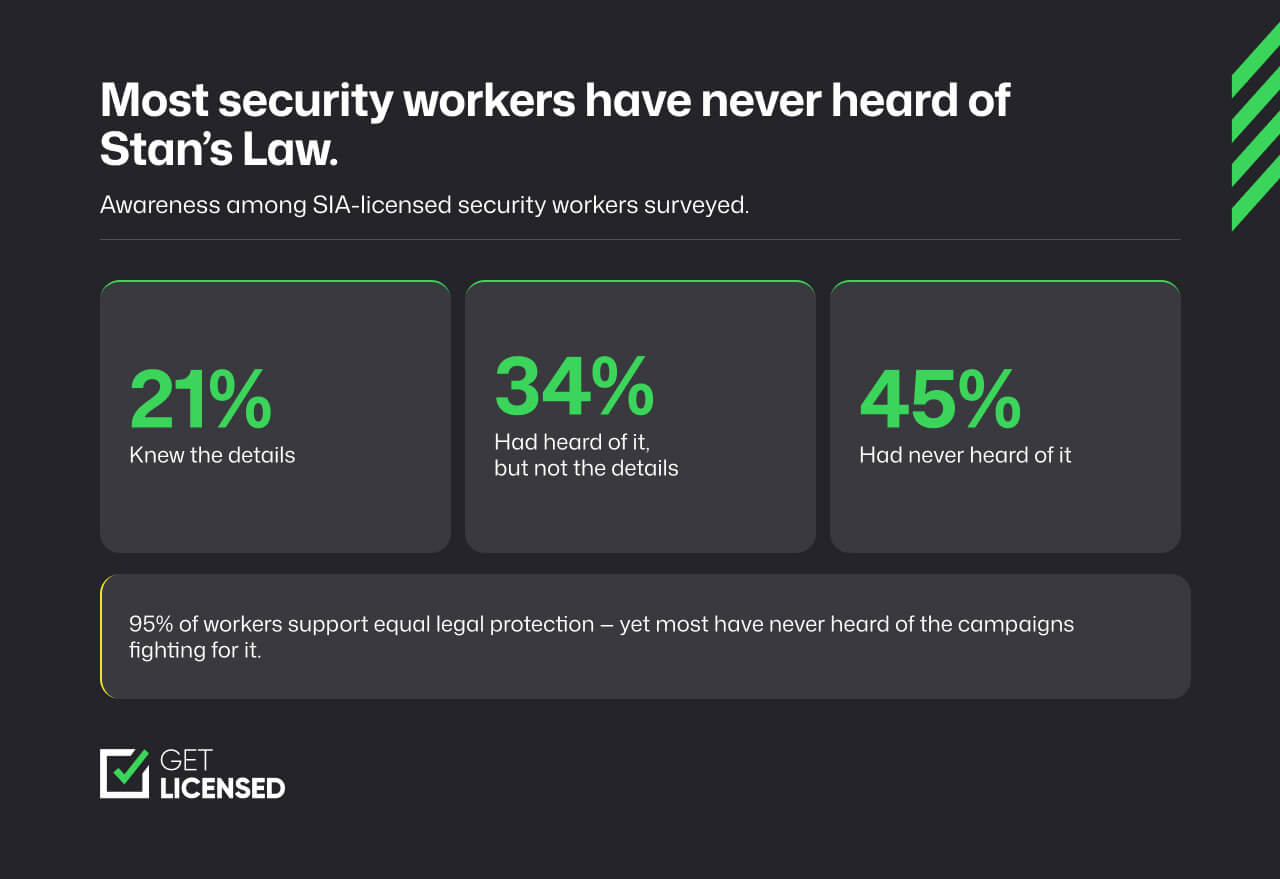
| Campaign awareness | Stan's Law | Petition 750121 |
|---|---|---|
| Know the details | 21% | 17% |
| Heard of it but don't know the specifics | 34% | 28% |
| Never heard of it | 45% | 54% |
Almost half of the workers Stan's Law would protect have never heard of the campaign. More than half have never heard of the parliamentary petition. This is not a failure of the campaigns — both are recent, both are gaining signatures, and the SIF has driven significant traction in trade press.
It is, however, a clear opportunity. The workers most affected by the legislative gap are also the workers least likely to be informed about the effort to close it. There is a role here for training providers, employers, and industry bodies in surfacing both initiatives to the licensed workforce.
How Workers See the Industry
Asked to characterise how well the security industry currently protects its workers, respondents offered a measured but critical view:
- 46% say the industry tries, but there are significant gaps in how workers are protected
- 26% say the industry does very little — most of the burden falls on us
- 21% say the industry does a good job
- 7% had not formed a view
In total, 72% of security workers believe the industry has significant protection gaps or fails to protect frontline officers.
Compared to two or three years ago, 58% feel that the risks facing security officers have got worse (42% "significantly worse," 16% "somewhat worse"). 15% feel risks are about the same. Only 13% feel risks have improved.
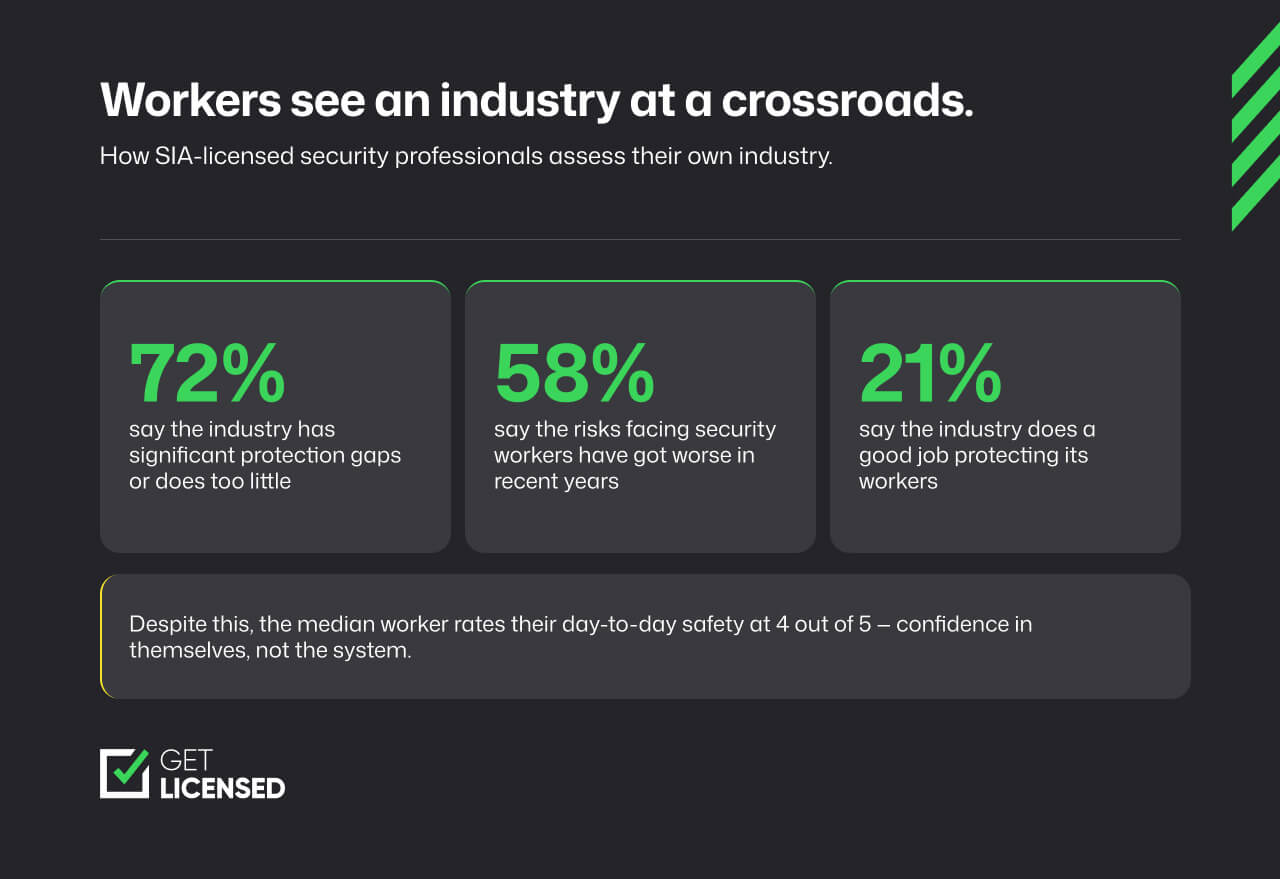
Despite that, day-to-day perceived safety holds up: on a 1–5 scale, the median worker rates their safety on a typical shift at 4, with a mean of 3.54.
This is consistent with the wider picture. Workers feel competent and prepared in the moment — but they see the trajectory of the industry, and the standards it operates under, as moving in the wrong direction.
Considerations and Recommendations
The findings in this report point to a coherent set of changes. They are presented here as considerations for the parties best placed to act on them.
For Employers and Security Organisations
Re-examine equipment provision as a professional standard, not a cost line
The gap between what workers are provided (12% have stab vests) and what they want (97% support some form of standard) is too wide to be explained by operational variation alone.
The 62% refusal rate among workers who have asked for protective equipment suggests that, in many cases, the answer is reflex rather than reasoned.
Invest in ongoing development
97% of workers say they would take up further safety training if offered. Employer-funded refresher and specialist training is one of the cheapest credibility signals an operator can send to its workforce — and one of the most effective retention levers in a sector with chronic turnover.
Reconsider lone-working practices on high-risk sites
30% of respondents always or mostly work alone. 46% identified reducing lone working as a top safety priority. Sites that cannot be safely staffed by one person should not be staffed by one person.
For Industry Bodies and Regulators
Develop a minimum equipment framework for high-risk SIA-licensed roles
83% of frontline workers want a mandatory SIA standard. The combination of high-risk operational contexts (night-time economy, retail, large-scale events) and inconsistent voluntary provision argues for a defined floor — not a uniform mandate across all roles.
Build ongoing CPD into licence renewal
The data shows both a high baseline rating for current SIA training and a near-universal appetite for more. A modest CPD requirement at renewal would convert latent demand into actual competence.
For Policy and Government
Review the scope of the Assaults on Emergency Workers (Offences) Act
94% of workers want it, and the assault rate (31%) and weapon-threat rate (19%) reported in this survey indicate the exposure profile the legislation was designed to address. Stan's Law and petition 750121 are not advocacy outliers; they are aligned with the position of the workforce they would protect.
Recognise the relationship between pay, retention, and safety
57% of workers cited higher pay as a top safety priority. This is a labour-market signal, not a wage complaint. When experienced workers leave, less prepared workers replace them, and the risk profile of the industry shifts.
The Path Forward
Security workers know what they need. The findings of this survey are not fragmented or contradictory — they are coherent, ranked, and overwhelmingly aligned.
88% lack the protective equipment they need. 62% of those who have asked for it have been refused. 31% have been physically assaulted on duty in the last year. 19% have been threatened with a weapon.
And yet 97% want minimum equipment standards, 94% want legal parity, 97% want more training, and 74% want stronger legal penalties for assault.
This is what professional standards in UK security should look like, articulated by the people who do the work: equipment provision that matches the risk, legal recognition that matches the role, training that matches the appetite, and compensation that matches the exposure.
The data does not point to a single fix. It points to a settlement — one that brings the standards of the industry into line with the standards of the work.
The role of organisations like Get Licensed in that settlement is a defined one: deliver high-quality SIA training, support workers through ongoing development, and ensure that worker voice is represented in the conversation about how this industry operates. This report is an attempt to do the last of those things.
The next step belongs to employers, the SIA, and the government.
Methodology
This research was conducted via an online survey administered between April and May 2026. The survey covered equipment provision, incident exposure, training, perceived risk, policy preferences, and awareness of current advocacy campaigns. It was distributed to Get Licensed's database of past SIA-trained learners and through Get Licensed's industry-facing channels.
271 raw responses were collected. All percentages are calculated against this base unless otherwise stated. Multi-select questions report the share of respondents selecting each item; totals therefore exceed 100%. The sample is concentrated in London (24%) and the English Midlands; while every UK nation and English region is represented, regional subgroup analysis should be treated cautiously.
The findings reflect the views and experiences of those who chose to respond. Workers who feel most strongly about the issues raised may be over-represented relative to the licensed population as a whole. Incident data is self-reported.
References
[1] Health and Safety Executive. (2025). Violence at Work 2024 to 25.
[2] UK Legislation. (2018 ). Assaults on Emergency Workers (Offences) Act 2018.
[3] UK Government. (2022 ). Police, Crime, Sentencing and Courts Act 2022.
[4] UK Government. (2025) Crime and Policing Bill 2025.
[5] Home Office response to petition 750121.
[6] Change.Org (2026). Stan’s Law Campaign.
[7] BBC News (2026). Murder Arrest in Milton Keynes.


Find work, try mock tests and book courses from
the UK’s #1 app for security professionals



Get Licensed helps you get SIA trained, licensed, and ready for real security jobs — trusted by 450,000+ people across the UK.
Copyright © 2026 | All rights reserved